“But We Are Peaceable”
Milan Mentz
Chicago’s “Haymarket Affair” Revisited—German-Americans, May Day, and a Legacy of (Anti-)Left Radicalism in Retrospect
On May 4, 1886, a dynamite bomb exploded during a workers’ protest at Chicago’s Haymarket Square, leaving behind a crater that far exceeded its explosive force. While it killed one Illinois police officer and wounded several others, the totality of this bomb’s brisance could not be measured in TNT equivalent. Its repercussions were of a different kind: The event prompted a spectacular court trial that infamously sentenced seven innocent men to die. Moreover, Haymarket lastingly changed the perception of labor radicalism and far-left activism in the United States.
140 years later, this article undertakes a retrospective survey. It explores these events within their historical contexts and assesses the cultural legacy the “Haymarket affair” leaves behind.
1848–1886: Radicalism’s Rise and the Eight-Hour Movement
It is difficult to overstate the importance of immigration to the American labor sector. Consistently throughout the latter half of the nineteenth century, it was those considered most alien and foreign who enabled the United States’ industrialization and economic growth. Formerly enslaved Black people grafted on plantations and fields in the South, Irish workers toiled in Northeastern factories, and Chinese immigrants built the continental railroad along the Western frontier. All of them faced harsh conditions, but none were recognized by the white, native-born majority of Americans for their efforts. Although workers from all these groups occasionally engaged in strikes, revolts, and protests, they almost never shared a coherent set of emancipatory ideals guiding and uniting their efforts.[1]
Enter Germans. The 1850s marked the arrival of so-called Forty-eighters to the US, refugees fleeing political crackdowns after the failed revolution in 1848. These privileged, usually young, unmarried, and university-educated men held far more coherent and progressive views than most of their new compatriots and had a profound impact on American cities’ intellectual, cultural, and political spheres.[2] Ranging from moderately liberal to decidedly communist, some of them laid the groundwork for socialist ideas to take hold in the country: Radical leftists like Joseph Weydemeyer and Friedrich Sorge began forming political associations like the American Workers League or the New York Communist Club in the 1850s. In 1869, the International Workingmen’s Association (IWA or International) established a US branch and 1876 saw the formation of the Workingmen’s Party of the United States—the first Marxist party in America.[3]
These groups were all heavily dominated by German immigrants: Even their conventions, publications and calls to action were all in German. In German-American workers’ communities in industrialized cities like New York, Philadelphia, and Chicago, socialist associations, newspapers, and union federations wielded considerable influence. Only after 1890 did socialists in the US seriously begin trying to appeal to the English-speaking majority of the population.
By the end of the 1870s, US labor radicalism shifted dramatically. Following the 1878 anti-socialist laws of German chancellor Otto von Bismarck, which criminalized all socialist and social democratic activities in the Reich, numerous more radically minded actors emigrated to the US. While these ‘Seventy-eighters’ brought new life to labor movements, they also made matters more contentious. Anarchism’s rise threatened socialists’ previous dominance: It promised direct political action, seemed less theory-heavy and esoteric and overall more accessible than Marxism. More importantly, it capitalized on a pervasive political demand far more effectively than socialists had managed to in prior years: the eight-hour workday.
At a glance, demands for reduced hours in the US had an impressive track record: The first-ever general strike in American history in 1835 Philadelphia had mainly rallied around this cause, successfully limiting shifts to ten hours a day.[4] In the 1860s, the National Labor Union demanded an eight-hour workday. Although lawmakers reacted with initial concessions, these laws were full of loopholes and did not lead to an improvement of working conditions. Moreover, courts voided them in the 1870s.
The first modern May Day demonstration had taken place in Chicago on May 1, 1867. Although the eight-hour movement declined during the economic depression of the 1870s, it resurfaced with a vengeance in the following decade. Socialist and anarchist groups in New York and Chicago took up advocacy for the cause again, which previously had been dominated by unions.[5]
It all culminated in 1886: Across the country, tens of thousands of workers took their protest to the streets. In New York, a diverse coalition of political groups held a mass demonstration attended by over 30,000 people. Across the country, 300,000 workers went on strike. In Chicago, a known hub of German-American radicals and anarchists in particular, the May Day rally comprised a staggering 80,000 individuals. The parade was led by prominent anarchist Albert R. Parsons, accompanied by his wife Lucy and their two children. Despite thousands of heavily armed police officers and National Guard troops warily overseeing the rally, all remained peaceful.[6]
The 1886 Haymarket “Riot”
The protests continued over the coming days across multiple cities, but nowhere did they reach a momentum close to that in Chicago. Here the strikers steadily grew in numbers, as protestors marched from workplace to workplace and urged fellow workers to join them in their efforts. On May 3, 1886, a large crowd demonstrated against strikebreakers in front of a factory in Chicago’s West Side. When a number of them tried to enter factory grounds police opened fire, killing at least two and severely wounding many more. Outraged, local anarchist groups called for a protest rally the following day at Haymarket Square.[7]
The meeting in question was held on the night of May 4, 1886, but its turnout was disappointing. Just two to three thousand workers were present, and it got underway late. Eventually, German-American anarchist August Spies was the first to address the crowd, followed by the American Albert Parsons, who spoke for about an hour. Amidst the audience stood Chicago’s mayor Carter Harrison Sr., who, to his own surprise, recognized both the crowd and the speakers as widely peaceful. Convinced the meeting was a harmless one, he left the scene just as Parsons’ speech was concluding. Before his departure, he advised police inspector John “Black Jack” Bonfield to dismiss law enforcement reserves and leave the crowd be.[8]
Samuel Fielden, a British-American anarchist, spoke last. A few minutes into his address it started to rain, prompting many to leave. No more than three hundred onlookers were present for the remainder of Fielden’s speech. Referencing the massacre just a day before, Fielden described “the law” as a murderous entity, one that was exclusively dedicated to the protection of property—and then added an edgy metaphor about how this “law” should be “throttled” to death.[9]
To Inspector Bonfield, that was reason enough to disperse the crowd. He ordered his men into position just as Fielden issued his concluding remarks to the crowd. The crowd was just getting ready to leave, when police captain William Ward addressed them, “I command you, in the name of the people of the state of Illinois, immediately and peaceably to disperse!” A perplexed Fielden replied, “But we are peaceable,” followed by, “All right, we will go,” and stepped off his wagon.[10]
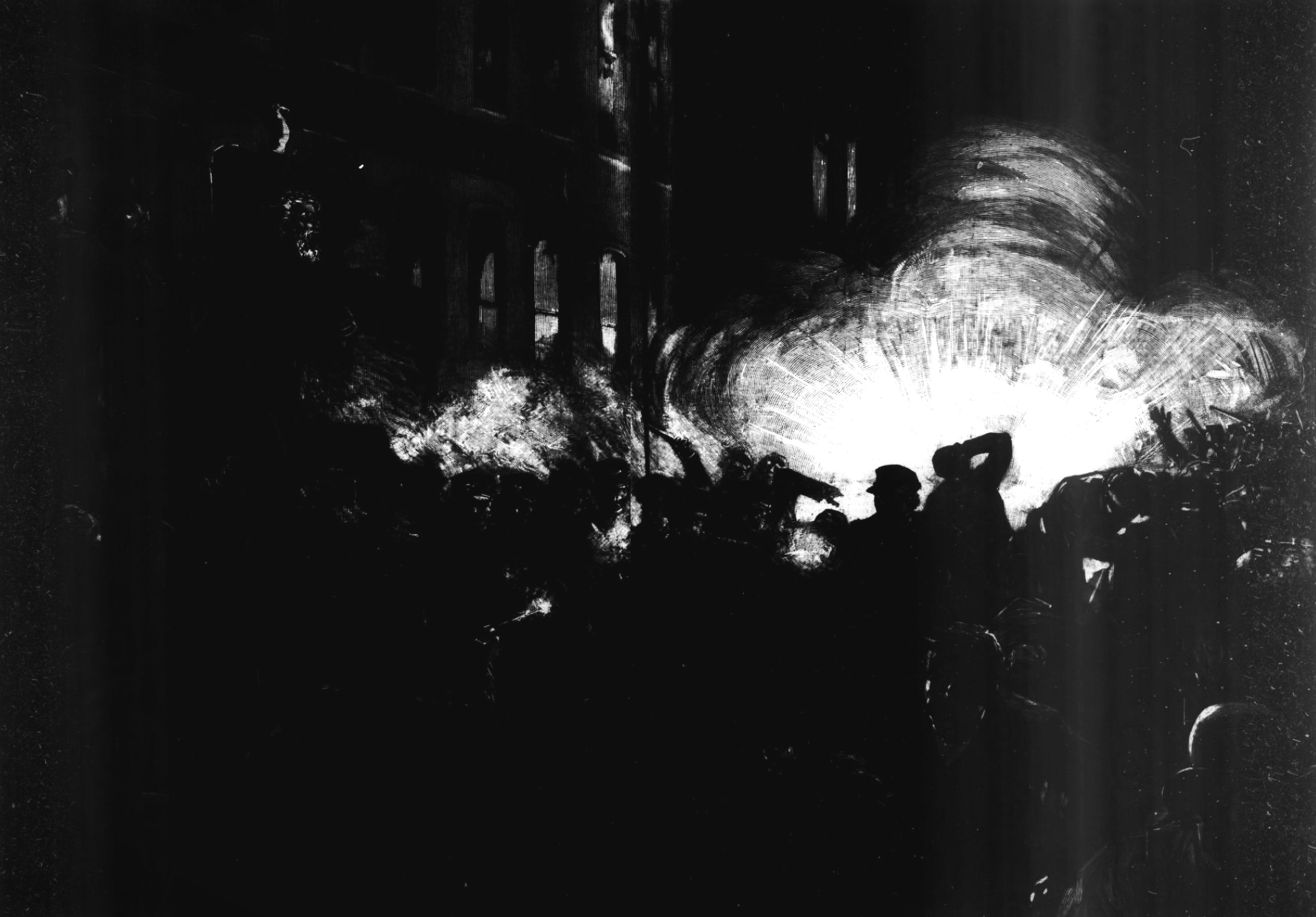
At this moment, someone hurled a dynamite bomb. It landed amidst the police forces and detonated violently, injuring several officers and causing glass windows several blocks away to shatter. After a short moment of silence, the police started firing indiscriminately into the crowd, which in panic tried to flee in all directions. After they kept up the gunfire for several minutes, officers proceeded to march through the adjacent streets and beat anyone in proximity who did not immediately comply with their orders. Even the conservative-leaning newspaper Chicago Tribune referred to the policemen as in a state of “madness”, adding they were “as dangerous as any mob, for they were blinded by passion and unable to distinguish between the peaceable citizen and the Nihilist assassin.” [11] After about five minutes, Haymarket Square was littered with bodies. Almost seventy policemen lay injured, eight of which succumbed to their injuries. However, only one of them unquestionably died from the bomb: All others had been shot and injured by their own comrades. While a small number of protesters had been armed, no credible reports exist of anyone besides the police firing weapons. The exact number of civilian casualties is unknown, but it almost certainly exceeded that of the police.[12]
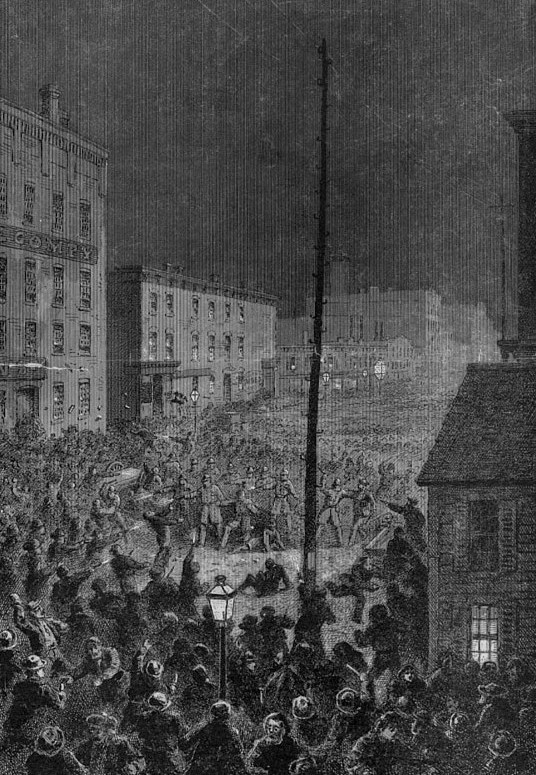
As historian Paul Avrich has underscored, “[…] leaving aside the unidentified bombthrower, it was the police and not the anarchists who were the perpetrators of the violence at the Haymarket.” All accounts by eyewitnesses, be it protesters, journalists, policemen, or the mayor of Chicago, agree that the meeting had been peaceful, and, moreover, was in the process of dispersing anyway. Inspector Bonfield furthermore had been quoted before as determined to disperse the meeting, come what may. Fielden’s dramatic metaphor of “throttling the law” likely was the last chance the inspector saw for doing so—and he took it. Had “Black Jack” Bonfield not intervened, however, no bomb would likely have been thrown, the square would have been empty minutes later, and there would be no reason in particular to remember this day. [13]
“Hans Socialist” and “the Goddess of Murder”: Political, Legal, and Cultural Fallout, 1886–1887
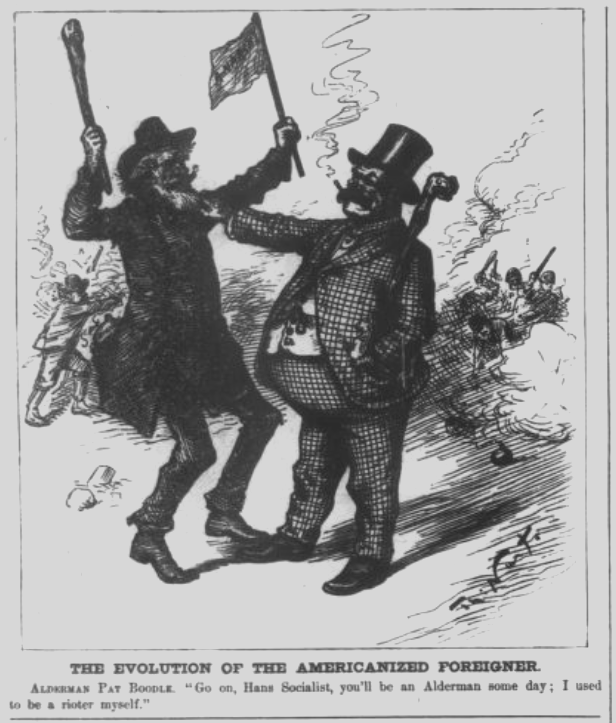
In the immediate aftermath, public attention zeroed in on immigrants and activists. Like the historian Henry David rightly noted as early as 1936, it was the dawn of America’s first “Red Scare.”[14] There seemed to be a silent consensus between established print media outlets and police forces that for a certain time, for a certain people, all gloves were off.
The day after the bombing, The New-York Times, for instance, as a matter of course deemed “the villainous teachings of the Anarchists” solely responsible for the carnage—and furthermore felt it necessary to point out that anarchist speaker Parsons was married to a “negro wife.”[15] Several outlets described a “mob […] crazed by a fanatic desire for blood” and the New-York-based political magazine Harper’s Weekly wrote of “brutal ruffians, all of whom seem to have been foreigners, […] men who openly advocate massacre and the overthrow of intelligent and orderly society.”[16] Such was the reporting, that Spies, Parsons, and Fielden to large parts of the population effectively seemed to have thrown the bomb themselves. The press’s frenzy contributed to a widespread panic and animosity toward anti-capitalist activists and German-Americans. Nativist and anti-radical sentiments were at a decades-long high. The Chicago Tribune even called for far more moderate German-American socialists like George Schilling to be hanged.[17]
Unions across the country hectically distanced themselves from any suspicions of radical tendencies, perhaps none more overt than the Knights of Labor, whose Chicago periodical published a disavowal arguably no less drastic than what could be found in conservative media—despite the fact that Albert Parsons had been one of Chicago’s first KoL members.[18] In short, labor organizations practiced anticipatory subservience in hopes of avoiding the line of fire.
Meanwhile, the Chicago police illegally conducted warrantless raids and arrested hundreds of suspected anarchists, mostly German-Americans. Most were never tried, yet the police still held them in cellars of their headquarters for weeks on end. For two months, Chicago effectively experienced a state of martial law. The police upended the right to free assembly and prohibited public gatherings under threat of incarceration. Leftist newspapers and periodicals of the city were shut down for anywhere between a month and one and a half years, with some never recovering. This period of exceptional police reign drew from the financial support of Chicago business owners who paid large sums of money to those police departments and judicial prosecutors that went above and beyond to eradicate anarchism from the face of the city.[19]
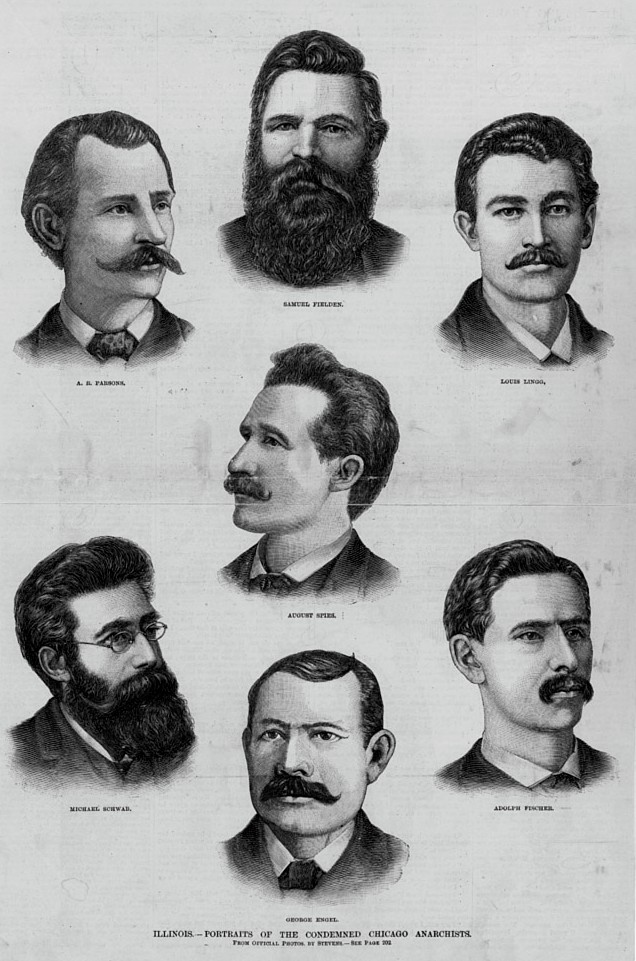
On the morning of May 5, police officers raided the office of the German-language labor newspaper Arbeiter-Zeitung, arresting editor August Spies and his brother Christ, as well as the editorial assistant Michael Schwab and typesetter Adolph Fischer. A few days later followed the arrests of the paper’s office manager Oscar Neebe as well as of Fielden and the German-American anarchists Louis Lingg and George Engel, of which only Fielden had even been at Haymarket on May 4.
Albert Parsons, who had left the city, was nowhere to be found, despite extensive search efforts. Police followed, harassed and repeatedly arrested his wife Lucy for a duration of six weeks, hoping she would lead them to her fugitive husband. Yet Albert Parsons only turned back up once the trial began on June 21, 1886. Calmly entering the courtroom on day one, he stated he wished to be tried alongside his comrades Spies, Fielden, Schwab, Fischer, Lingg, Engel, and Neebe.[20]
The Haymarket trial against the eight defendants dragged on for two months and is widely remembered as one of the low points in American judicial history, a textbook example of an unfair trial. Much of this can be ascribed to the presiding judge Joseph Gary, who treated his defendants with open contempt. Moreover, he oversaw the selection of a carefully handpicked jury, a process that took three weeks and involved the examination of close to a thousand candidates. The court almost exclusively admitted avowedly biased jurors: Several of the jury’s members declared themselves a priori convinced of the defendants’ guilt and that they wished to see them hang. The admitted jurors even included a physical relative and a personal friend of deceased policemen. Meanwhile, the court outright rejected anyone with a background of union membership or even mild communist or anarchist sympathies.[21]
The prosecution’s case largely rested on lengthy presentations of anarchist newspapers and pamphlets, mainly in an attempt to paint August Spies as the mastermind behind the bombing. The strongest case could arguably be made against Lingg, who actually had been in the possession of explosives, but there was no proven connection to the one thrown at Haymarket. As all the defendants had airtight alibis for the moment the bomb was thrown, the state prosecutor Julius Grinnell focused on the much vaguer concept of a “conspiracy to commit murder.” Yet, the prosecution also produced no evidence that the unknown bomb thrower had acted at the behest of any one of the defendants.[22]
This, however, did not turn out as a problem for the prosecution: Judge Gary, in his closing remarks on the trial’s last day, declared the utterance of speech encouraging or endorsing violence sufficient to consider its authors murderers. A murder had taken place, the identity of the true culprit did not matter. This was a bold interpretation of the law that not only lacked legal precedent but was also wholly unconstitutional. Before World War I, the United States’ constitutional guarantees à freedom of speech were so unfettered that they—in theory—covered the right to express radical beliefs or insurrectionary language. Even explicit calls for violence would have been completely protected.[23] In practice, however, the jury delivered guilty verdicts for all eight defendants. All but Neebe (who received fifteen years imprisonment) were sentenced to die. Neither an appeal to the Illinois Supreme Court nor to the federal one could sway the verdict.[24]
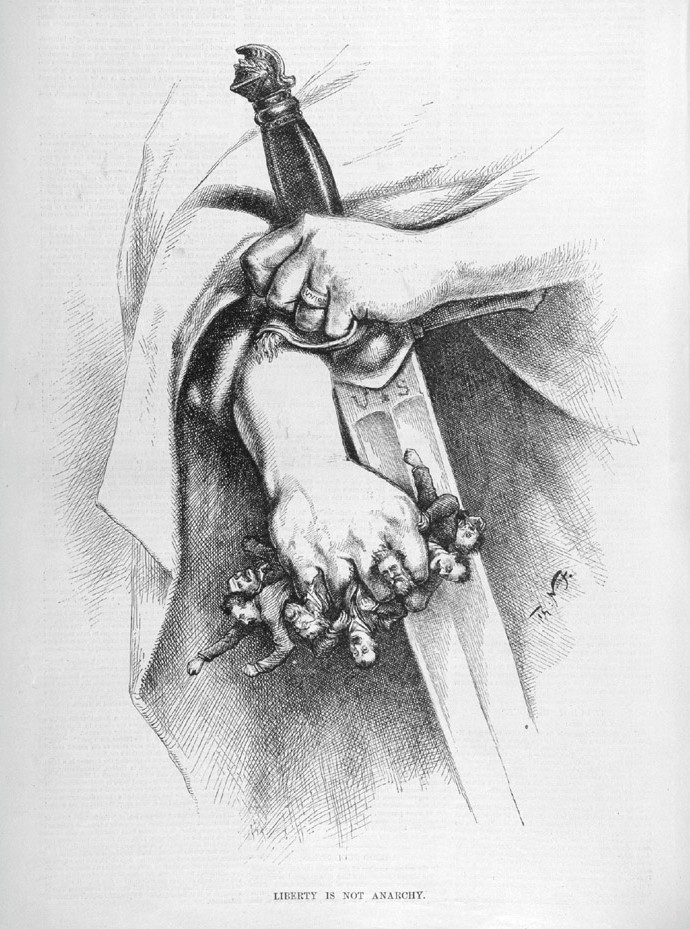
A majority of the population approved of the courts’ decision and most media outlets hailed it as a victory of justice. However, public opinion had already started to grow slightly more nuanced during the trial and the verdict led to an outpouring of support among leftist camps. The German-language socialist newspaper Philadelphia Tageblatt, for example, published an editorial entitled “Anarchists Are Whom They Start With.” It argued, quite foresightedly so, that anti-anarchist sentiments were just the beginning and would eventually serve to justify far more widespread anti-labor measures. The article drew an interesting comparison to Otto von Bismarck’s anti-socialist laws in Germany and called for solidarity with the defendants.[25] In the weeks following the verdict, Lucy Parsons traveled through American cities to speak to sympathetic workers on behalf of her husband, his comrades, and anarchism more broadly.[26]
Over the course of 1887 the defendants rose to international prominence. In Europe, social democrats and socialists tried to balance the perceived impetus for solidarity with their own political disdain for anarchism. Notably, many socialist newspapers either referred to the defendants as “socialists” or used political neutral terms such as “the accused.”[27]
As tempers in the US cooled, more and more people favored a reassessment of a case that, evidently, had not been a criminal one. Rather, a political ideology had been put on trial and its representatives unlawfully sentenced to hang—based on the emotional conviction that their beliefs constituted an evil that had to be done away with.
The very last effort to save the defendants’ life came by means of a petition signed by 100,000 American citizens criticizing the trial and asking for mercy. Prominent intellectuals like Friedrich Engels, Oscar Wilde, and George Bernard Shaw also weighed in, as did Samuel Gompers, the well-respected president of the American Federation of Labor (AFL). Subsequently, Illinois governor Richard Oglesby agreed to issue pardons on the condition that the defendants asked as much in writing. Fielden and Schwab did and had their sentences commuted to life in prison. Spies, Parsons, Fischer, Engel, and Lingg refused. Lingg even went a step further and defiantly took his own life, by means of an explosive device smuggled into his cell. His death, as widely publicized, was an agonizing and slow one, leaving him conscious in excruciating pain for about six hours.[28]
By the time the executions approached in late 1887, much of the earlier bloodlust had withered away. Media reports either grew more charitable, humanizing the defendants upon seeing their spouses and children for the last times, or limited themselves to matter-of-fact-based reporting.
On their way to the gallows on Friday, November 11, 1887, the white-robed convicts sang the “Workers’ Marseillaise” before setting foot on the scaffold at Cook County Jail. Opposite them sat around 200 witnesses. Lucy Parsons had not been permitted to see her husband one last time; officers instead repeatedly told her to approach a different entrance until it was too late.
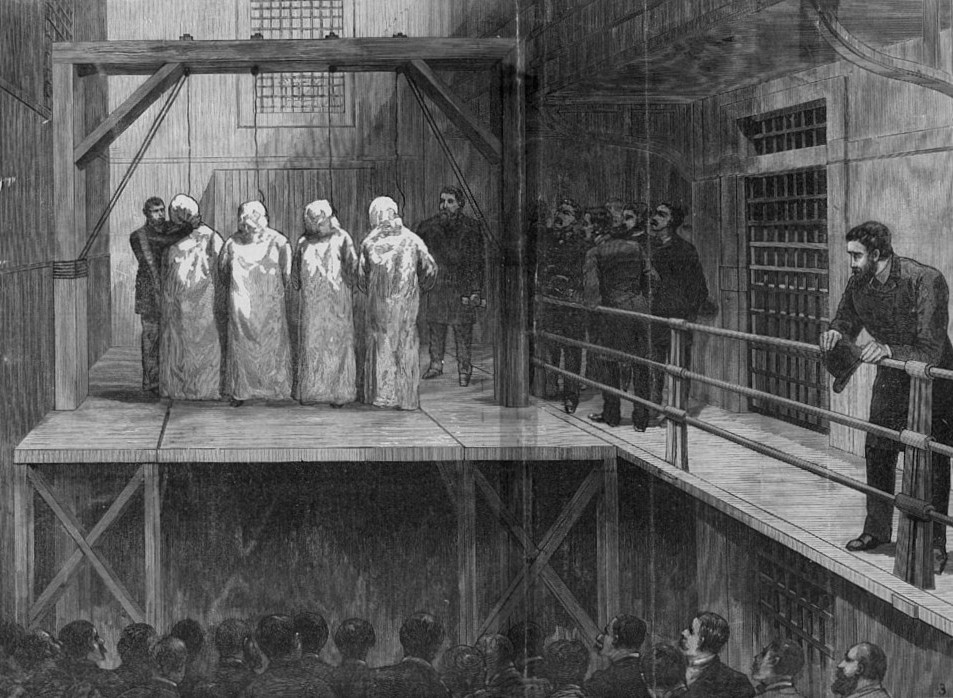
The four moribund anarchists remained defiant to the end. Once the hoods had been placed over their heads, Spies exclaimed, “The time will come when our silence will be more powerful than the voices you strangle today!,” to which Fischer and Engel added, “Hurrah for anarchy!” Finally, Parsons raised his voice, asking, “Will I be allowed to speak, O men of America? Let me speak, Sheriff Matson! Let the voice of the people be heard! O—.” At that moment, the trapdoor opened and the four men fell to their deaths. Spies’, Fischer’s and Parson’s bodies twitched wildly for several minutes, in what eyewitnesses later described as a surreal scene of complete silence. After almost eight minutes, they were pronounced dead; several of the onlookers were visibly shaken by what they had witnessed.[29]
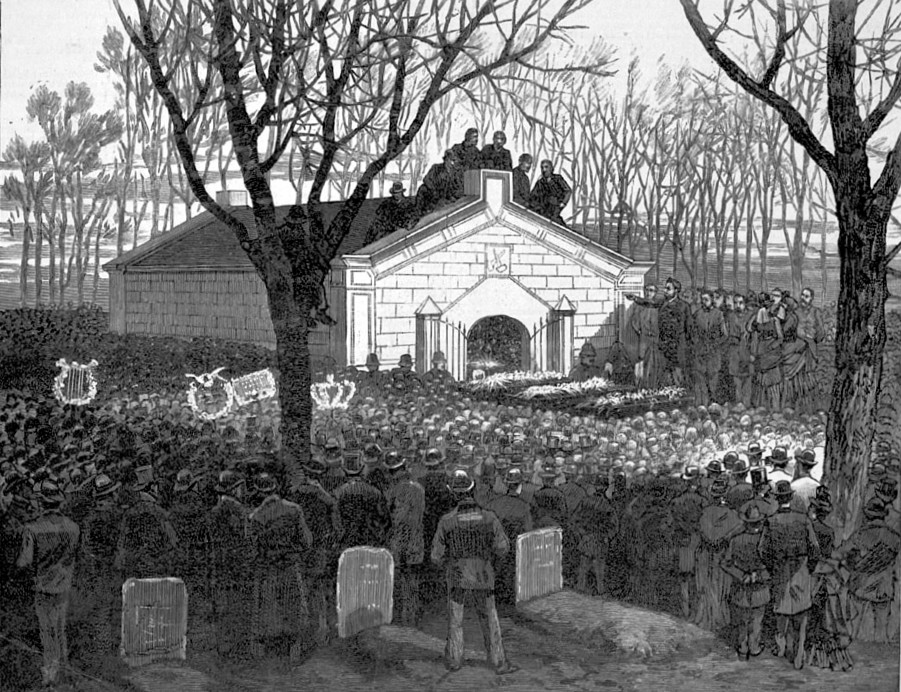
The New-York Times celebrated it as a “decent and orderly execution,” one that had “vindicated” the “violated law.”[30] The funeral on November 13, however, told a different story. The then-largest funeral in Chicago history, 20,000 people attended the ceremony and an estimated 200,000 spectators observed the prior procession through the city’s streets.[31]
Legacy
Interpretations regarding the legacy of Haymarket differ. Some consider the martyrial iconography it spawned beneficial to subsequent radical traditions in the US and think it sparked a mythical interest around anarchism. However, it must be acknowledged that anarchism as a mass movement in Chicago effectively ended with the event—its presses and venues were in disarray, its followers intimidated, and its most influential leaders executed.[32] Moreover, the country’s biggest labor federations, namely the Knights of Labor and the AFL, reacted by decidedly pulling its members away from anti-capitalist radical thought in the late 1880s, which had previously been widespread or even dominant within the broader labor movement. Still, many union members faced political persecution and labor organizations overall suffered greatly, with some (like the Knights of Labor) never to recover from their decline in membership.
Moreover, Haymarket inseparably linked anarchism with terror and destruction in the eyes of many and enabled business owners to rescind much of the progress made in prior years: wages decreased and workdays often reached up to ten hours again.[33] The Haymarket affair set a precedent of anti-left state action in lockstep with a widely publicized media witch hunt. This, to a certain degree, engrained in the United States’ national identity the idea that the country’s declared ideals of liberty and justice for all were under threat primarily by radical emancipatory movements—rather than lawless police mobs or a biased judicial branch unconstitutionally canceling out the First Amendment. Here, then, at the very latest, lay the roots of America’s rich history of anti-left doctrine, which far predates the Progressive Era or even the Cold War.
The assault on German-Americans, likewise, was nothing short of extraordinary. As Walter D. Kamphoefner put it, Haymarket was the “incident that most indelibly stamped German immigrants with a radical reputation.”[34] In some ways, this paved the way for future nativist and anti-radical waves of state-sponsored attacks targeting German-Americans, such as in the wake of World War I.[35] There are scholars like Hartmut Keil who reject this “Haymarket exceptionalism,” stating that the US had in fact demonstrated nativist tendencies and similarly repressive measures before, even though the Haymarket fallout certainly concerted such measures.[36]
Whatever the case may be, Haymarket’s symbolic relevance as a whole is difficult to deny: Four avowedly freedom-loving men hanged for a crime they did not commit in the “Land of the Free,” that lent itself well to satirization. Shortly after the executions a French anarchist magazine, for example, mocked the Statue of Liberty, France’s gift to the “Free World” that had been unveiled mere weeks after the verdict. The anarchists now suggested it be renamed “the Goddess of Murder.”[37]
In the following years anarchists, socialists, and social democrats across North America and Europe held annual commemorative events on November 11, the date of the executions.[38] The most lasting legacy Haymarket leaves behind, however, almost certainly is May Day. In the years after 1886, May 1 became an annual rallying event for labor activists, radicals as well as more moderate civil society members to commemorate the victims of Haymarket by staking out political demands of their own. Over time, although fiercely competing over cultural interpretations, they produced a transnational tradition, one which soon developed a myriad of cultural identities entirely of its own.
After May Day spread to Europe, the annual ritual East of the Atlantic gradually removed itself from its initial ties to Haymarket. Over time, they disappeared almost entirely.[39]Yet, when German workers sang Jacob Audorf’s “Worker’s Marseillaise” at May Day parades in the 1920s, they did so, knowingly or not, because four anarchists in Chicago had sung it before them—on their way to the gallows, on a “Black Friday” in the Fall of 1887.
[1] Ronald Takaki, A Different Mirror: A History of Multicultural America (Little, Brown and Company, 1993).
[2] Lesley-Ann Kawaguchi, “The Making of Philadelphia’s German-America: Ethnic Group and Community Development, 1830–1893 (PhD diss., University of California, Los Angeles, 1983), 134. See also Kawaguchi’s article, “Diverging Political Affiliations and Ethnic Perspectives: Philadelphia Germans and Antebellum Politics,” Journal of American Ethnic History 13, No. 2 (1994).
[3] Isobel Plowright, “The International Workingmen’s Association in the United States, 1865–1876” (PhD diss., Columbia University, New York, 2024), 82–89 and 149. By the end of 1877, the WPUS had rebranded itself under the name Socialistic Labor Party or SLP. See Philip S. Foner, The Workingmen’s Party of the United States: A History of the First Marxist Party in the Americas (MEP Publications, 1984).
[4] Philip S. Foner, History of the Labor Movement in the United States, Volume I: From Colonial Times to the Founding of the American Federation of Labor, 5th ed. (International Publishers, 1975), 115–29.
[5] Donna Haverty-Stacke, America’s Forgotten Holiday: May Day and Nationalism, 1867–1960 (New York University Press, 2009), 15–18; Foner, Labor Movement I, 372–82; Philip S. Foner, History of the Labor Movement in the United States, Volume II: From the Founding of the American Federation of Labor to the Emergence of American Imperialism (International Publishers, 1975), 98.
[6] Haverty-Stacke, May Day, 29–30; Howard Zinn, A People’s History of the United States, reiss. (Harper Perennial, 2015), 269–70; Paul Avrich, The Haymarket Tragedy (Princeton University Press, 1984), 186–87.
[7] Zinn, People’s History, 270–71; Avrich, Haymarket Tragedy, 188–89.
[8] Avrich, Haymarket Tragedy, 199–204.
[9] Avrich, Haymarket Tragedy, 204–5.
[10] Avrich, Haymarket Tragedy, 205–6.
[11] Avrich, Haymarket Tragedy, 206–7; Chicago Tribune, May 5, 1886, https://famous-trials.com/haymarket/1187-hellishdeed [April 30, 2026].
[12] Avrich, Haymarket Tragedy, 207–10.
[13] Avrich, Haymarket Tragedy, 210–14.
[14] Henry David, The History of the Haymarket Affair, rev. ed. (Russell & Russell, 1958), 528.
[15] The New-York Times, May 5, 1886.
[16] The Philadelphia Inquirer, May 5, 1886; Pittsburgh Daily Post, May 5, 1886; Harper’s Weekly, May 15, 1886.
[17] Avrich, Haymarket Tragedy, 218–19; Chicago Tribune, May 7, 1886.
[18] Avrich, Haymarket Tragedy, 219–20.
[19] Avrich, Haymarket Tragedy, 221–23 and 227.
[20] Edward de Grazia, “The Haymarket Bomb,” Law and Literature 18, No. 3 (2006): 309; Douglas O. Linder, “The Haymarket Trial: An Account,” Famous Trials: Accounts and Materials for 100 of History’s Most Important Trials, https://famous-trials.com/haymarket/1181-home; Chicago Tribune, June 22, 1886, https://famous-trials.com/haymarket/1190-news6-22 [April 30, 2026]; Avrich, Haymarket Tragedy, 224–32.
[21] Avrich, Haymarket Tragedy, 263–67; Linder, “An Account.”
[22] Jesse Rivers/Tamara Jameson/Vincent Bates, “The Haymarket Trial,” Famous Trials, https://famous-trials.com/haymarket/1201-studentpage; Avrich, Haymarket Tragedy, 268–77.
[23] Avrich, Haymarket Tragedy, 277–78; de Grazia, “Haymarket Bomb,” 308.
[24] Rivers/Jameson/Bates, “Haymarket Trial”; Avrich, Haymarket Tragedy, 279–80 and 297–300.
[25] Philadelphia Tageblatt, August 27, 1886.
[26] Between October 31 and November 14, 1886, Lucy Parsons spoke publicly in Philadelphia at least three separate times. Philadelphia Tageblatt, November 1 and 15, 1886.
[27] Raymond C. Sun, “Misguided Martyrdom: German Social Democratic Response to the Haymarket Incident, 1886–87,” International Labor and Working-Class History 29 (1886); Hubert Perrier et al., “The ‘Social Revolution’ in America? European Reactions to the ‘Great Upheaval’ and to the Haymarket Affair,” International Labor and Working-Class History 29 (1886).
[28] Linder, “An Account”; Avrich, Haymarket Tragedy, 353–76.
[29] Avrich, Haymarket Tragedy, 391–93; Linder, “An Account.”
[30] The New-York Times, November 12, 1887.
[31] Avrich, Haymarket Tragedy, 395–98.
[32] Haverty-Stacke, May Day, 33.
[33] Avrich, Haymarket Tragedy, 430–33.
[34] Walter D. Kamphoefner, Germans in America: A Concise History (Rowman & Littlefield, 2021), 235.
[35] See Bill Lynskey, “Reinventing the First Amendment in Wartime Philadelphia,” The Pennsylvania Magazine of History and Biography 131, No. 1 (2007).
[36] Hartmut Keil, “The Impact of Haymarket on German-American Radicalism,” International Labor and Working-Class History 29 (1986).
[37] Perrier et al., “European Reactions,” 38.
[38] Perrier et al., “European Reactions,” 45–46.
[39] Haverty-Stacke, May Day, 34–72.
Top photo: Thure de Thulstrup, “The Anarchist Riot in Chicago—A Dynamite Bomb Exploding among the Police,” Harper’s Weekly, May 15, 1886, 312–313.)
Milan Mentz is a historian focused on Historical Communism Studies, Transnational Social Movements of the 19th and 20th Centuries, and Shoah/Sonderkommando Studies.