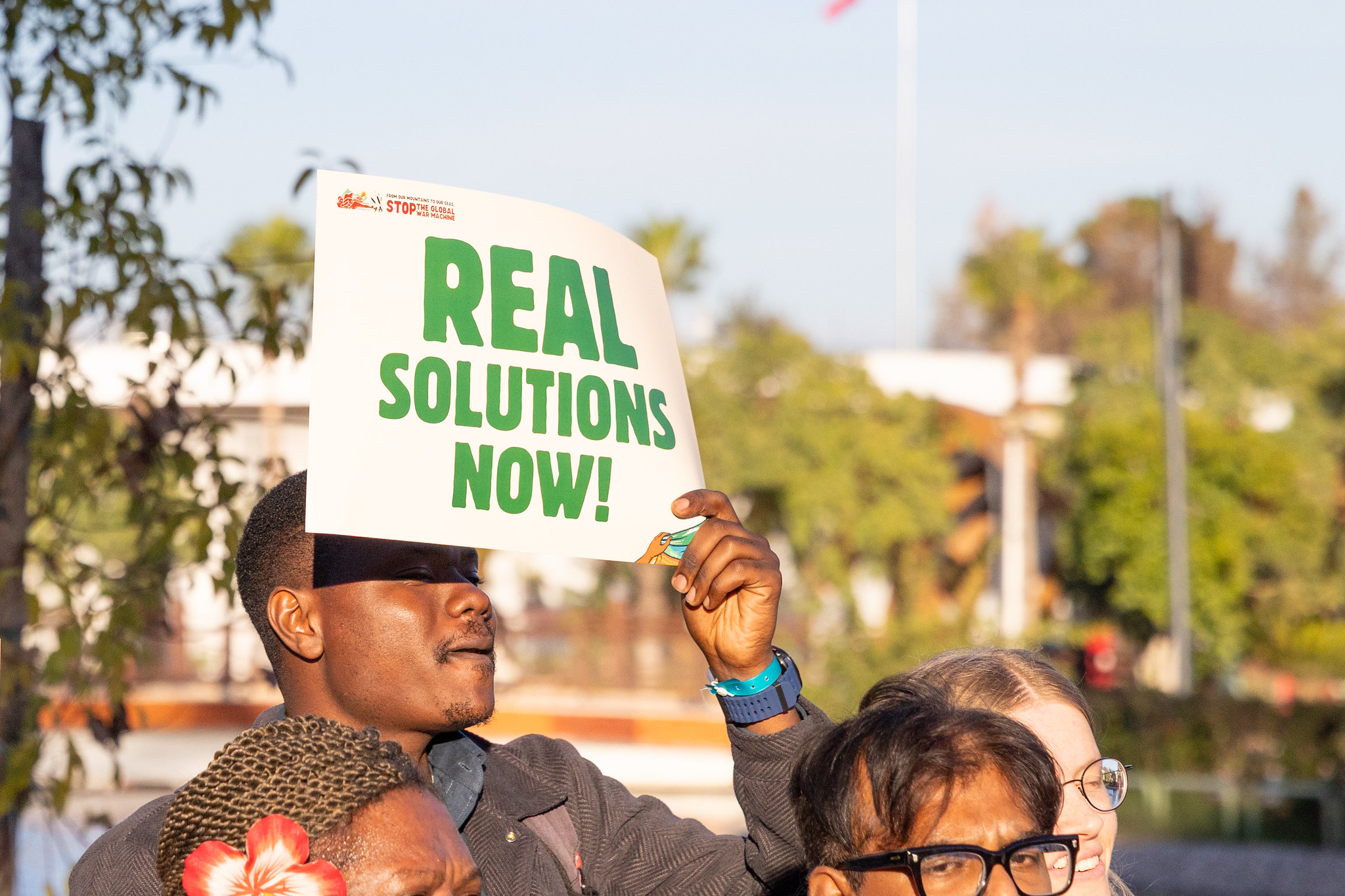
Making Polluters Pay: The Road to COP31 and Beyond
Tetet Lauron and David WilliamsWorld leaders are meeting in Antalya, Türkiye, from 9 to 20 November for the UN climate negotiations – for climate justice it needs climate finance as well as structural reforms to address unjust debt and taxation
Speaking at the United Nations General Assembly in New York in September 2026, UN General Secretary Antonio Guterres called on world leaders that polluters “must pay” for the climate crisis. According to a recent report by Oxfam, the richest 8 million people (0.1 percent of the global population) are responsible for more emissions than the poorest 3.5 billion. As world leaders descend on Turkey over the coming two weeks to participate in COP31, the annual negotiations of the United Nations Framework Convention on Climate Change (UNFCCC), the question is to what degree those responsible can be held to account.
A fundamental tool in the collection of those seeking more progressive outcomes could be last year’s Advisory Opinion (AO) of the International Court of Justice on Obligations of States with respect to Climate Change. The judges unanimously declared that states could be held responsible for lack of climate action and furthermore, in cases where they are found negligent, to pay reparations. The upcoming negotiations are considered by many to be the first in which the AO could have a meaningful impact, with climate negotiators likely using it in their attempts to hold rich industrialized nations to account for their historical pollution.
Within the next few years, global temperature rise is set to surpass the 1.5°C warming threshold governments agreed upon at COP21 in Paris in 2015. Based on current climate policies, global temperature is projected to increase by approximately 2.6°C compared to pre-industrial levels by 2100. In spite of this concerning trajectory, the commitment made at COP28 in Dubai to transition away from fossil fuels could not be reaffirmed last year at COP30 in Belém, a failure of international climate diplomacy.
Where will the money come from?
One of the more positive outcomes from Belém was the establishment of the Just Transition Mechanism to deal with the question of what happens to workers in the fossil fuel sector and how they can be treated fairly as industries transition toward renewable energy. The mechanism makes strong references to important progressive principles such as workers’ rights, decent working conditions, bottom-up approaches, and International Labor Organization guidelines for a just transition. Negotiations in Antalya will be key to bring this mechanism to life, navigating thorny questions such as who runs it, which authority will it have, how will it relate to other COP processes, what say will be given to workers, trade unions, indigenous groups and civil society, and how will it be funded.
But it is not only reducing emissions that depends on finance, but also responding to climate impacts. As seen in the horrific disasters in Nepal and Bhutan recently, the question increasingly becomes how affected countries are meant to respond to the increasing impacts of climate change without adequate finance. Storms, floods, heatwaves and droughts are wreaking havoc amongst local communities, breaking records for losses and damages caused each year. In this Super El Niño year, it is more important than ever to ensure that the most vulnerable communities in developing countries have equitable access to the resources necessary to rebuild their lives.
Finance has also long been one of the key sticking points of the negotiations. Industrialized countries which caused the crisis have continuously undermined their obligations, showcasing a lack of commitment to providing adequate amounts of climate finance to developing countries. The most recent example of this is Germany, which announced that it only provided 4.7 billion US dollars in climate finance in 2025, as opposed to the 6 billion US dollars it had committed itself to. In addition, the funding which has been provided has often been in the form of loans or investments, contributing to the debt burden of affected countries as well as allowing companies to profit.
Two years ago at COP29 in Baku, a new climate finance goal (known as the New Collective Quantified Goal on Climate Finance, or NCQG) of 300 billion US dollars was set, to be provided annually by 2035. Importantly, it was decided that developed countries were merely to “take the lead” in providing that finance. This goal was complemented by another mechanism (known as the Baku to Belém Roadmap, or B2BR) to mobilize 1.3 trillion US dollars in finance flows annually by 2035. Who was to provide it remained unclear however, or even in what form, as it encompassed private investment, blended finance, loans and other financial instruments.
This was viewed by many developing countries and observers as developed countries flagrantly evading responsibility for having caused the climate crisis. Following intense pressure from developing country negotiators at COP30 in Belém the following year, a work programme was established under Article 9 of the Paris Agreement, which addresses the question of whose responsibility it is to actually provide climate finance. The aim at COP31 in Antalya is to strengthen developed countries’ commitments through this work programme, to which they are certain to mount significant resistance.
Unustainable debt and taxation
Without drastic intervention, climate finance is at risk of becoming merely another investment opportunity. This runs counter to its intended purpose of supporting developing countries in tackling climate change by making polluters pay up for the destruction they have caused. The problem is exacerbated by the decline of Official Development Assistance (ODA), as well as the rising cost of goods and looming food shortages in developing countries caused by geopolitical conflicts and trade disruptions, illustrating the risk of a major fiscal crisis.
It is important to note therefore, that while filling the various funds created within the UNFCCC would go some way to alleviating pressure on many affected countries, economic and climate justice advocates are increasingly pointing to the more underlying issue of fiscal space. Huge debt payments in many countries of the Global South are constraining the ability to adequately resource critical social services, with more budget being spent on debt servicing, or in some cases merely the interest on that debt, than on healthcare, education, and public transport. On the other hand, domestic resource mobilization, mostly generated through taxation, is also key to opening up fiscal space. However, developing countries lose billions of dollars a year as a result of tax evasion and illegal financial flows.
The UN Tax Convention is entering its critical phase with negotiations taking place just after COP31 in Nairobi. The process was initiated by a group of African countries to close loopholes, rebalance structural inequities, and redistribute taxing rights through global cooperation on taxation. Next year’s COP32 is being hosted in Ethiopia, a region where fiscal space is particularly constrained by unsustainable debt burdens and limited opportunities for domestic resource mobilization. The hope is that momentum around the issues of fiscal space, and how to reform the deeply unjust international debt and tax architecture, can reach beyond the COP negotiations and into national parliaments and other multilateral for a to create meaningful change.
Civil society under pressure
The success of the annual climate summits is in large part determined by pressure from civil society, as well as host country leadership. This year’s negotiations will be co-led by Australia and Turkey, neither of which have much to show in terms of progressive climate policy, particularly regarding the use and export of coal. Even more concerningly, Turkey’s track record on human rights and civil society participation is highly contentious. The Turkish government has detained Antalya’s elected Mayor under corruption allegations, even further restricted press freedom in closing down the last remaining pro-opposition TV network, and also expanded its crackdown on the LGBTQI+ community.
The People’s Climate Summit is still expected to go ahead, if under significant pressure from national government. Organizers have planned an alternative civil society space accessible to the public to supplement the highly restrictive formal negotiation space. NGOs and networks from around the world have been invited to host events and discussions, sharing perspectives and learnings over 5 days on important topics such as fossil fuel phaseout and energy democracy, food sovereignty and agroecology. However, the ability to receive funding and to find a host venue has been challenging for the organizers under the current administration. A climate justice march is also planned through the city of Antalya at the halfway point of negotiations, though whether and under which restrictions this demonstration can take place will remain to be seen.
It is not the first time COP has been hosted by an authoritarian government. The hope is that civil society will still be afforded the opportunity and safety to advocate for holding those responsible to account. In the context of the climate negotiations, this means making the big polluters, both countries and corporations, pay up and provide reparations for the harm they have caused. The narrative of scarcity fed by industrialized nations needs to be debunked. Wealth and resources are abundant, yet they remain profoundly unequally distributed.
David Williams is the director of the International Climate Justice Program at the Rosa Luxemburg Foundation in New York.
Tetet Lauron lives in the Philippines and works as a consultant for the Rosa Luxemburg Foundation’s New York office.
Photo: “Civil Society Actions” by UNclimatechange, CC BY-NC-SA 4.0