Mining Exposes the Limits of the Energy Transition
Katarine Flor
A mini-documentary reveals how the race for “green” minerals reproduces global inequalities and reframes the climate crisis as a power struggle
The promise of a global energy transition is often presented as inevitable and consensual. In the face of the climate crisis, replacing fossil fuels with renewable sources appears as a technical, urgent, and universal solution. The mini-documentary Mineração, Lucro e Devastação – A farsa da transição energética breaks with this narrative by shifting the perspective: instead of asking how to accelerate the transition, it asks whom it serves—and at what cost.
The film was produced by the Latin American Climate and Energy Program of the Rosa Luxemburg Foundation in partnership with Brasil de Fato. Check out the documentary teaser with English subtitles.
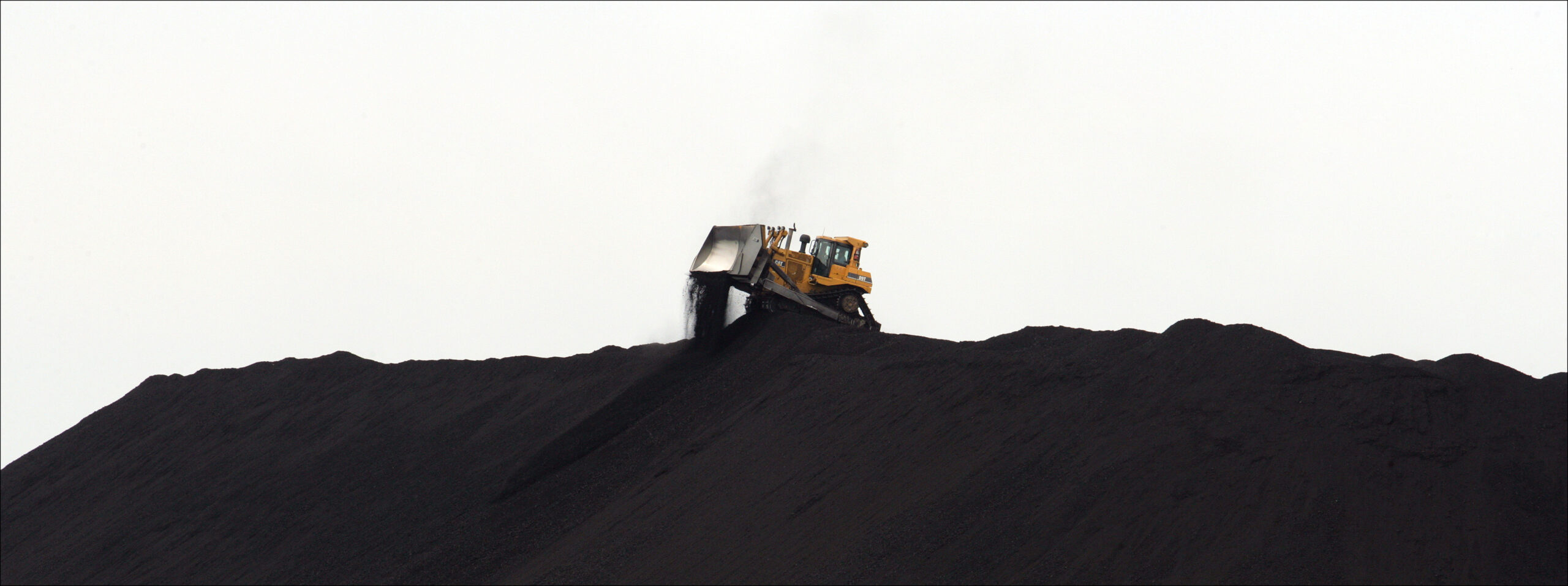
The film reveals that the so-called energy transition, far from representing a break with the previous model, has operated as its continuation. The expansion of mining for strategic minerals—such as lithium and other essential inputs for “green” technologies—exposes a familiar pattern: territories in the Global South converted into zones of intensive extraction, where environmental and social impacts are treated as necessary externalities.
The expansion of the exploitation of strategic minerals—such as lithium, which is fundamental for “green” technologies—has intensified globally. According to the report Em Nome do Clima, demand for lithium could increase by more than 8,000% by 2050.
This growth takes place in a sector that already carries significant socio-environmental implications: according to an analysis by the Observatório da Mineração, based on data from McKinsey, mining accounts for about 7% of global greenhouse gas emissions.
In this sense, the documentary shows that the climate crisis is not being addressed merely as an environmental problem, but as a field of economic and geopolitical reorganization. The current energy transition does not break with the power structures that produced the crisis; it reorganizes them. It does not fundamentally change the energy model, as it increases energy production from “renewables.” What remains is the logic of exploitation.
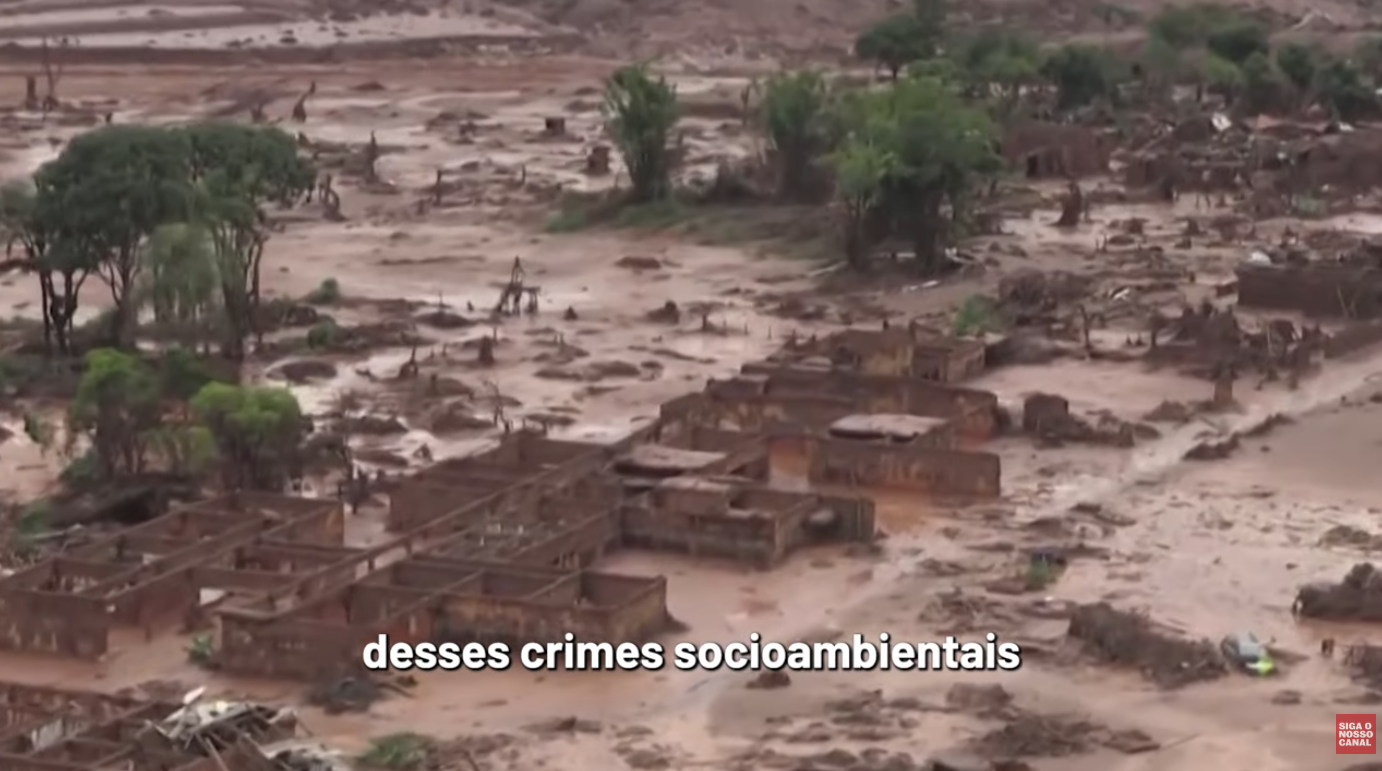
By following the concrete effects of mining on territories and communities, the film dismantles the idea that we are facing a clean solution. The devastation does not disappear—it is displaced. And this displacement is not random: it follows historical lines of inequality that structure relations between the Global North and the Global South.
It is at this point that the documentary fits into a broader interpretation: that climate is, above all, a power struggle. What is at stake is not only the reduction of emissions, but the definition of which lives, territories, and economies will be preserved—and which will continue to be sacrificed in the name of a supposed common good.
The film’s impact also lies in exposing how this dynamic is sustained by narratives. The energy transition is communicated as inevitable, technical, and depoliticized. Mining appears as necessary, almost natural stage in a larger process. In doing so, public debate is shifted: from politics to engineering, from conflict to consensus.
The documentary, however, reveals the opposite. There is no neutrality in this process. The way the transition is presented matters—because it defines what can or cannot be questioned.
By bringing to light the conflicts hidden by this dominant narrative, the film invites a reinterpretation of the climate crisis itself. It is not only about accelerating solutions, but about disputing the terms in which these solutions are formulated. Because as long as the energy transition is conducted within the same logic that historically produced inequality, it will tend to reproduce it.
Mining, Profit and Devastation does not offer easy answers—and perhaps that is its greatest strength. Instead, it exposes a central contradiction of our time: the attempt to solve the climate crisis through mechanisms that depend on the continuation of exploitation.
If there is one thing the film makes clear, it is that there is no neutral transition. And that, without confronting the power structures that organize this transformation, the risk is not only failing to solve the climate crisis—it is deepening it under new justifications.
Teaser: Mining, Profit and Devastation – The farce of the energy transition | Documentary TEASER
Katarine Flor is a journalist and communication specialist, working on climate, cities, and democracy. She coordinates communications at the Rosa Luxemburg Foundation’s São Paulo office.
Related

Preparing a Public Pathway: Confronting the Investment Crisis in Renewable Energy
Sean Sweeney and John Treat