The Decolonization Book
Sean Jacobs
Over the summer, an edited book I’ve been working on for several years finally appeared: The Palgrave Handbook on Decolonizing International Affairs, which I co-edited with Sakiko Fukuda-Parr, my former colleague at the Graduate Program in International Affairs at The New School.
The Handbook brings together nearly 40 chapters spanning multiple disciplines and areas of intervention, offering resources for thinking about decolonizing international affairs, including Global Studies and International Relations. We hope it will help reshape how international affairs is taught and provide new foundational resources for research.
The book has a long history, rooted in our time at The New School and in conversations about how international affairs developed as a field of study. In our program, it grew out of conversations, friendships, teaching, disagreements, and collective work over many years. Our colleague, the late Lily Ling, taught an earlier version of the course. It’s wonderful to see it finally out in the world. It is also the final contribution Sakiko and I made together through our work there, as we both left The New School on June 1. Technically, Sakiko is still a faculty member as an emeritus professor. Sakiko is a brilliant scholar and colleague, and the perfect partner for such an undertaking. We were also fortunate to have two excellent assistant editors, Atash Nowzoorian and Mara Levi, both of whom were incredible. Mara worked as my RA, while Atash, who co-wrote the introduction, worked with Sakiko.
The contributors are an extraordinary group of scholars from around the world, including a fair number who live and work in countries in the Global South: Corinna Mullin, Jacquelin Kataneksza, Zachary Levenson, Carolina Salgado, Lyn Ossome, Joshua Myers, Bhumika Muchhala, Jenna Marshall, David Adler, Varsha Gandikota-Nellutlah, Hermann Derwanz, Geo Maher, Zachariah Mampilly, Ruchi Chaturvedi, Karen Tucker, Gabriel Vignoli, Nidhi Srinivas, Cresa Pugh, Serene Khader, Ying Chen, Yannis Bougiatiotis, Lisa Tilley, Ekaette Ikpe, Mihir Kanade, Mohamed Sesay, Peter J. Hoffman, Sedef Arat-Koç, Alessandra Mezzadri, Hanno Brankamp, Manjari Mahajan, Erica Levenson, Serkan Delice, Michael Kwet, Kristin Reynolds, Sheelan Qader, Prakash Kashwan, David McCoy, and Ramya Kumar.
The book also received public endorsements from a stellar group of scholars and others: Adom Getachew, professor and author of Worldmaking after Empire: The Rise and Fall of Self-Determination; Ha-Joon Chang, professor and author of Kicking Away the Ladder and Bad Samaritan; Sabelo J. Ndlovu-Gatsheni, professor and author of Empire, Global Coloniality and African Subjectivity; Jayati Ghosh, professor of economics at the University of Massachusetts Amherst and the most distinguished development economists globally and advocate for the Global South; and, of course, Stefan Liebich, a former Member of the German Parliament for Die Linke (The Left) and Director of the Rosa Luxemburg Foundation’s New York office.
Ha-Joon Chang, for example, noted in his endorsement that the Handbook “shows how the inefficiency and the injustice of the current world order cannot be addressed without fundamentally challenging the Western-centric, imperialist, and racist global knowledge system that has shaped and informs that order.”
To understand where this project came from, it’s worth going back to 2001, when urbanist Michael Cohen started the Graduate Program in International Affairs. The War on Terror was the dominant political backdrop, but the world was changing in other ways, too. Since then, we have seen the rise of the Latin American pink tide and people from Global South countries calling for United Nations reform, while scholarship experienced a growing decolonial turn. Questions arose about whether international affairs itself needed decolonization.
Then came the summer of 2020, with the nationwide—and eventually global—Black Lives Matter protests. Within IR, scholars began questioning the discipline’s racial foundations and the practice of international relations. I remember reminding colleagues that this was not simply an American issue. It was an international one. The United States was merely one type of state with settler colonial roots, and in no way exceptional. The histories of race, colonialism, empire, and struggles for freedom connect people and places worldwide.
The work that eventually became the Handbook first took shape in a course, Decolonizing International Affairs, which Sakiko and I took turns teaching before eventually co-teaching it. Both in the classroom and in this book, we tried to explore how people beyond the United States have grappled with the struggle to imagine and invent a fundamentally different world.
For me, the book is also about what happens to knowledge once we produce it. Most of our contributors work in academia, but I don’t want these ideas to remain confined to universities or circulate only among specialists, as I have done with my work on Africa Is a Country and here. That is why we insisted on making the book open access.
So what do we hope happens next? One danger is that the academic disciplines associated with international affairs absorb critiques without actually changing direction: they adopt some new language, congratulate themselves for being inclusive, and then carry on as before. I hope—and we hope—that this book helps interrupt that cycle.
We hope people will download the whole book or individual chapters, use them in their classes and political education, review the book, and perhaps help bring some of its ideas into the popular press. The book is completely free because it is open access. The contributors care about bringing knowledge to wider publics; otherwise, they could have kept these ideas in journals behind paywalls. We have Stefan and his colleague Julian Lattimore at the Rosa Luxemburg Stiftung’s New York office to thank for helping make this possible.
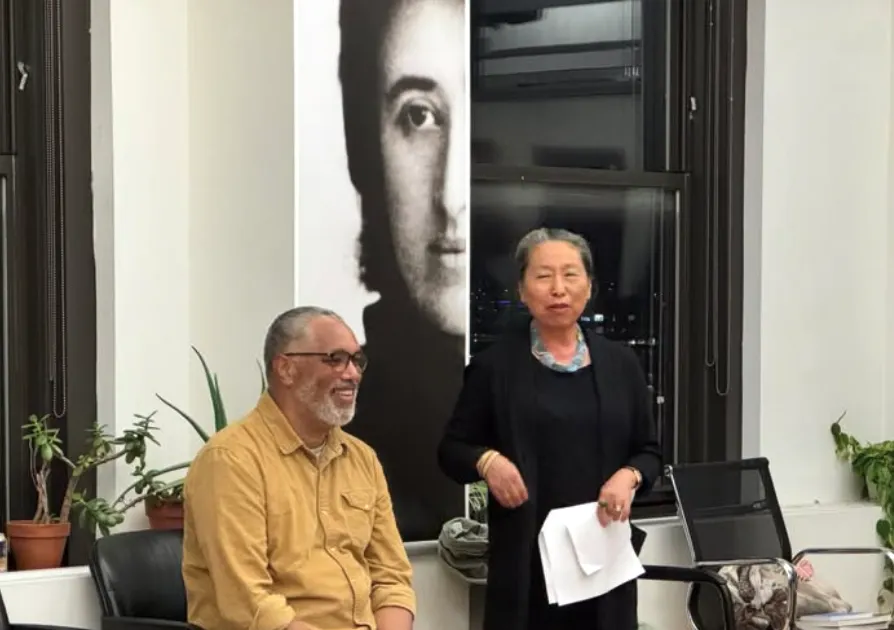
It seems that making the book open access was a good decision. At an in-person launch at the Rosa Luxemburg Stiftung’s New York office last week, our publisher, Anca Pusca at Palgrave, reminded us that the book had already accumulated 232,000 downloads of its chapters or the full book in less than three months after publication. Yesterday, Sakiko told me that Anca had updated the figure: we’re now over 240,000 individual downloads. Incidentally, when Lily became sick, Anca taught her class until the end of that semester.
For me, then, this book is an invitation to think differently about whose knowledge matters, how we understand the world, and how we might imagine alternatives to the international order we’ve inherited. It does the kind of work I associate with one of my favorite sayings, this one by Joãosinho Trinta, famous for his floats during Carnival in Rio: “The people like luxury. Those who like misery are intellectuals.”
He was definitely not talking about the people we brought together in this book.
Sean Jacobs is on the faculty of The New School and is Founder-Editor of Africa is a Country. He has written about football culture for Al Jazeera, Africa Is a Country, The New York Times, The Guardian and Roads and Kingdoms, among others.
This piece was first published on Eleven Named People Substack.

