
A Revolutionary in Politics and Photography
David BaconJeannette Ferrary, a fine photographer whose work has a rare and brilliant sense of humor, drew my attention to the obituary for Tina Modotti in The New York Times. I’m glad that the NYT series of obits on women who were ignored when they died chose to do one for Modotti. The author, Grace Linden, deserves credit for getting acknowledgement in the Times for this radical hero, 83 years after her death. Linden provides a thorough account of her work as a photographer in Mexico during the 1920s, where she is regarded as a founder of socially radical photojournalism and documentary work in Mexico.
Modotti was brought by her working-class parents to San Francisco’s North Beach around the turn of the century, from Udine, in northern Italy. Growing up, she began acting in local theater and moved to Hollywood, where she met Edward Weston. Linden pays a lot of attention to her relationship with Weston, a founder of modernism in photography. As Modotti, at 27, was searching for her way as a photographer and woman, the two went to Mexico together.
Weston had begun to discard the soft-focused pictorialism favored by established photographers of the day. His images of the Armco steel mill, taken in 1922, were historic in the development of modernism in their simplicity and sharp focus. His decision to use a steel mill as the place for this experimentation was partly due to the era’s progressive ideas about the importance of industry, and by implication, industrial workers. But he was not alone. Paul Strand made the same turn in that period. Later, in the 1930s, many photographers used factories for this purpose, but Weston and Strand were ahead of their time. We don’t see heavy industry in the same way today, but in those years, it seemed like the future.
Weston, together with Modotti, developed this vision further in Mexico. John Mraz, a respected photo historian, believes that the Mexican contribution to the development of photography is generally unacknowledged in the U.S. He argues that Mexico, where Weston created some of his iconic images, had a profound impact on him. Jason Weston, the photographer’s great-grandson, says, “his ideas about photography were very far along by the time he went to Mexico. His vision developed more there, but he had already made the jump from pictorialism to straight photography. This in no way diminishes the importance of Tina, either politically or photographically. Edward taught her photography, but she took it in her own direction.”
In Mexico, Modotti and Weston became more collaborators than student and teacher. Modotti joined the Mexican Communist Party in 1926, and combined her politics with the new modernist ideas of directness, sharp focus, and simplicity. That gave her work tremendous impact, including in the U.S. Her famous image of a hammer and sickle was a cover for The Masses at the height of the magazine’s popularity. It was one of a series in which she began with a straight depiction of the Communist symbol and then gradually transposed the elements. First, she added a sombrero, and eventually removed the symbols from the Russian Revolution, substituting a bandolier, guitar, and an ear of corn. She is clearly trying to “Mexicanize” communism, that is, provide symbols that make sense in Mexico’s own revolutionary history, that can provide the same political inspiration. The last photograph in the series is the one reproduced in the NYT obit, so the revolutionary intent is kept unclear. Perhaps the Communist symbols in the previous ones were too much for the NYT editors.
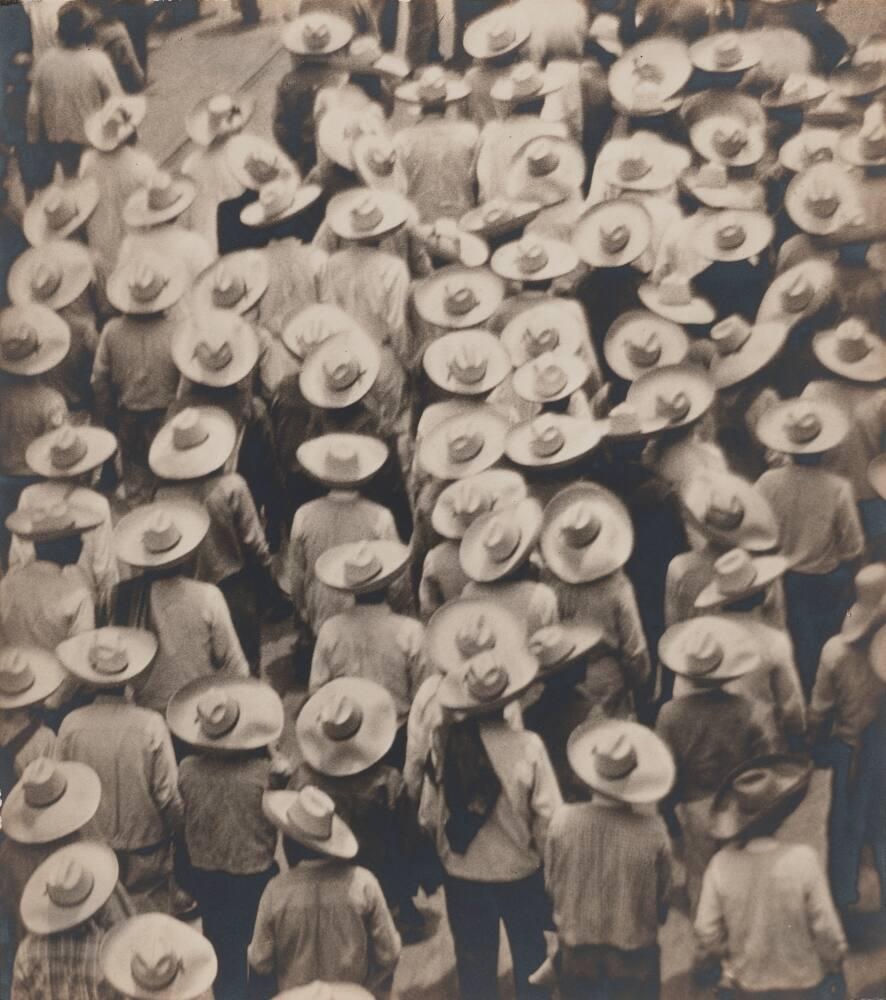
Linden’s account makes her a little too subservient to Weston. Modotti did ask him to teach her photography in Los Angeles before they even left. And she did recognize that her technical skill came from his. However, Modotti also employed the modernist aesthetic to give politics a new impact. The obit discusses her famous image of the workers’ march, where their massed sombreros, absent their faces, convey their political power and militance. Linden includes another worker photograph, showing worn hands resting on the handle of a shovel.
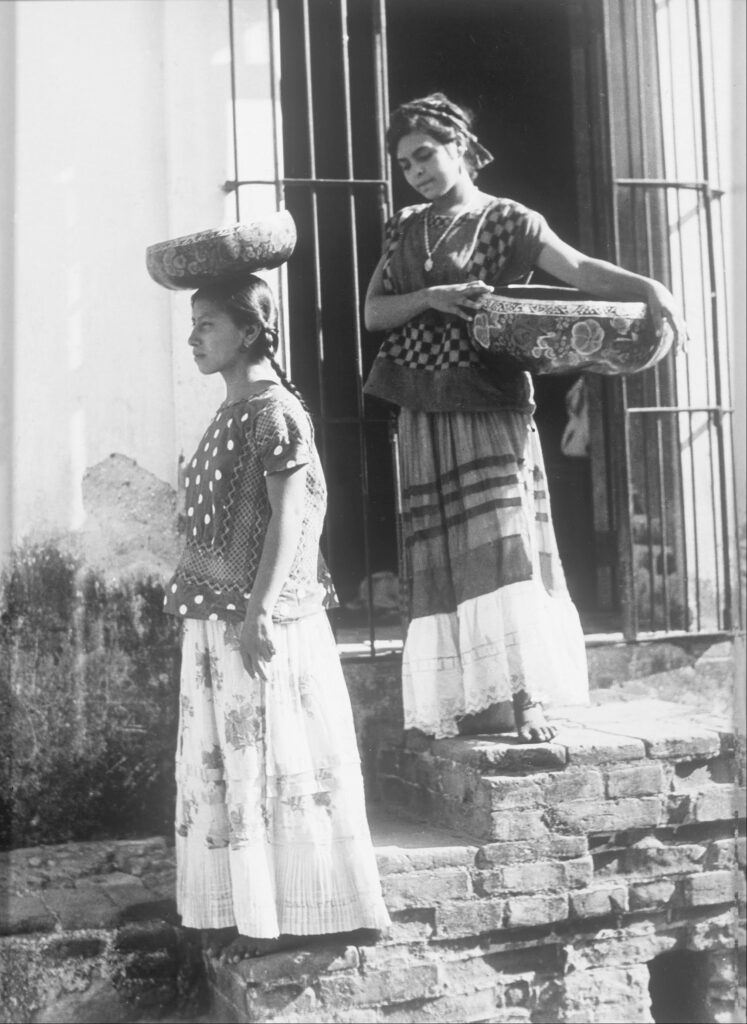
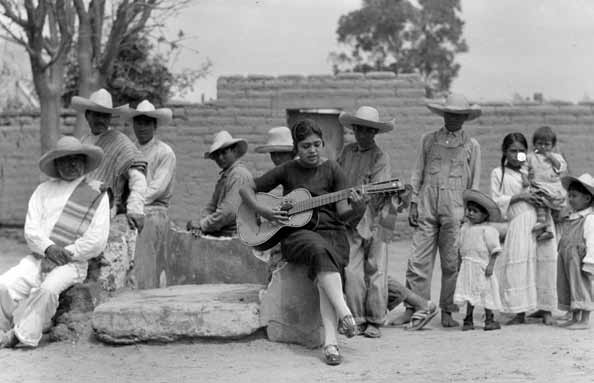
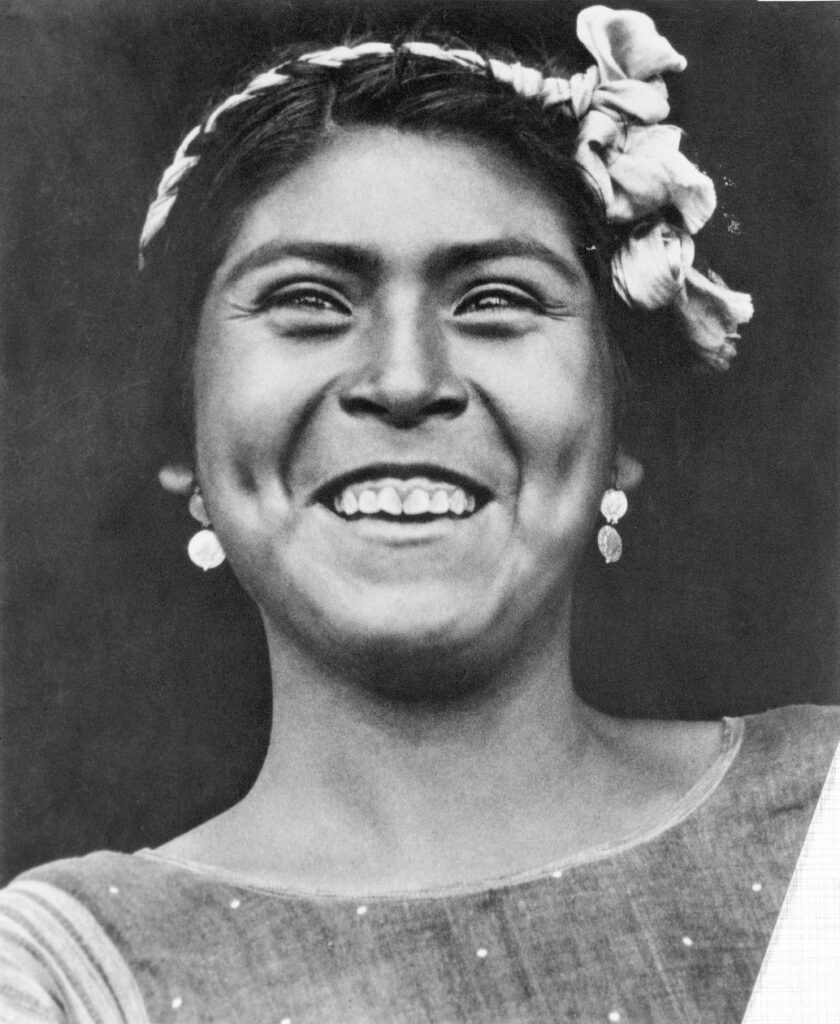
But Modotti didn’t stop there. She shot luminous portraits of women from indigenous communities, including another well-known image of a woman holding a baby, in which the light gives their skin and muscles almost three dimensions. She created other overtly political images. One shows a group of workers reading a copy of El Machete, the Communist Party newspaper. The message of the photograph is that the paper and its Party are speaking to the working class, and ordinary people are becoming literate as they participate in politics.
Modotti has been an important figure in feminist and women’s studies because of her genius as an artist, her independent life, and her unwillingness to subordinate herself to men (including Weston). The obit describes their lives in the bohemian atmosphere among artists and muralists in Mexico City in the late 1920s, just after the revolution.
Linden mentions that Modotti posed nude in several Weston photographs (among the most famous nude images in photography), and the online version of the obit reproduces one of them. These photographs are charged with the photographer’s sexual desire, but looking at them from Modotti’s perspective, as the person in the image, they seem very matter-of-fact. She doesn’t face the camera. There’s no come-on. Her attitude seems more, “this is my body, part of who I am.” Photography historian Sally Stein cautions, however, that “After those rooftop pics, she soon stopped, and we’re left to wonder whether she had growing reservations about photography’s potential, with regard to women.”
There’s no question that this is a colorful and fascinating part of Modotti’s life, and she plays such an important role in the history of photography that it deserves all the attention that Linden and other writers give to it. There are several books about Modotti, mostly focusing on her years in Mexico and her photography. One of the best is Tinissima, by the great Mexican writer Elena Poniatowska. But their authors generally have a much harder time with her life after she left Mexico. Linden’s obit shares that limitation, briefly presenting her travels after she left Mexico as spontaneous.
Due to her political affiliations, Modotti was deported in 1930 by Mexico’s incoming right-wing government, along with Vittorio Vidali, the Comintern’s representative in Mexico. The two eventually became partners, comrades, and lovers, a relationship that lasted to the end of her life. She stayed in Berlin for six months, where she began working for the Anti-Imperialist League, whose Mexican chapter she had helped organize. In Berlin, she tried to adapt to the new genre of street photography. Her deliberate process and old camera were too slow, however, and her poverty kept the new 35mm Leica out of her reach. With Vidali, she traveled on to Moscow, where she became an organizer for the Comintern. For several years, she worked for International Red Aid (the MOPR), smuggling money and support to imprisoned revolutionaries and banned political parties. In 1934, after Hitler took power, she and Vidali went back to Berlin to organize support for Georgi Dimitrov, on trial for the Reichstag fire, which Hitler used to suspend all civil liberties in Germany.
Her photographs from Mexico were widely published by Willi Munzenberg’s AIZ, the Workers’ Pictorial Newspaper. She gradually stopped taking pictures herself, however, but continued to contribute to the ideas of socially-committed photography. In 1932, she wrote “Photos as a Weapon for Red Aid Agitation.” According to Brigette Studer’s Travelers of the World Revolution, Modotti argued that photography makes possible the “objective” reproduction of the harsh reality of capitalism, but that images should not merely illustrate text, but should speak for themselves.
Modotti first went to Spain in 1933 and was deported. In 1934, she attempted to return to Asturias to provide support to the miners’ uprising and was stopped at the border. Then, in 1936, with the election victory of the Popular Front, she went back and stayed until the final retreat in 1939. During the Civil War, she was the head of Socorro Rojo, organizing all the support, first for the soldiers and civilian population, and then for the refugees as they fled from Franco. Vidali, under the name Carlos Contreras, was one of the organizers and later the political commissar of the Fifth Regiment.
During the war, Red Aid’s membership in France grew to 150,000, and in Spain to 500,000. Modotti moved from city to city, even by boat from Barcelona to Valencia, under the guns of the fascist-occupied coast. She was close to poet Antonio Machado, who called her “the angel of my house.”
As Franco’s armies advanced and the International Brigades left, “I felt anguish in my heart, and I thought about how this was the end,” she recalled. Vidali said he thought the war still might be won, but “You were always an optimist,” she responded. In the weeks that followed, she helped half a million people make their escape from Barcelona to the French frontier, under bombs and strafing planes. Antonio Machado died of pneumonia after crossing the Pyrenees. Her comrade at Red Aid, Mathilde Landa, stayed on but was captured and committed suicide after being tortured by the fascists.
Modotti left Spain with no possessions on February 9, 1939, and Vidali shortly afterwards. In France, the Mexican ambassador, Narciso Bassols, a Communist, obtained Mexican residence visas for Modotti and Vidali, as well as hundreds of other political refugees, including transit visas for the U.S. When the Queen Mary docked in New York, however, immigration authorities refused to let Modotti off the boat. Her sister, Yolanda Magrini, a Communist artist, tried in vain to see her and was unable to get on board. Modotti, who’d last seen the U.S. in 1923, was never able to return.
Linden describes the efforts of her friends to find her refuge in Mexico, but Modotti’s political history is basically missing from the NYT obit. The Mexican government, still under the influence of Lazaro Cardenas, gave asylum to thousands fleeing Spain. That decision had a great influence on Mexican photography. Among the refugees were the Mayo brothers, Communists who founded a radical photo agency that created a new, radical direction for photojournalism. The Mayos mentored a whole generation of red photographers that followed, from Rodrigo Moya to Marco Antonio Cruz.
That tradition had its influence north of the border as well. Mariana Yampolsky was born, raised, and educated in Chicago (a niece of Franz Boas), and emigrated to Mexico. Already a socialist, she went to work at the Taller de Gráfica Popular, bringing her into the Mexican left and close to the Mexican Communist Party. During the McCarthyite hysteria, like Modotti, she was denied the right to return to the U.S. Yampolsky was a brilliant photographer, very much in the Mexican tradition, and spent many years producing photographs for books for the Secretaria de Educación, when socialism was still taught in schools as a goal for Mexico. She was influenced by Modotti’s work and studied with Lola and Manuel Alvarez Bravo.
Modotti herself, however, didn’t return to photography. She described her motivation for giving up photography and working full time for revolution as hatred for “the intolerable exploitation of the workers of the countries of South America and the Caribbean” and the “bloody revenge on peasants who fight for their land, the torture of imprisoned revolutionaries, [and] armed attacks on street rallies and unemployed marches.” She died in 1942, in the middle of the war against Nazism, without seeing the final anti-fascist victory. The cause was most likely exhaustion and heart failure. Vidali returned to Italy afterwards and was a Communist leader in the Senate from Trieste for many years.
Modotti was a dedicated member of the Communist Party and spent the second part of her working life fighting for revolution. Blanking out this part of her life does no justice to the political sophistication of her ideas, or to her commitment to photography. Her decision, and the way she tried to balance those commitments, contradicts the bourgeois idea that artists must sacrifice everything for their art. She believed that communism and fighting fascism were more important than her photography, a revolutionary position.
All of that, I think, makes it unlikely that she will be as idolized (at least in mainstream media) as Frida Kahlo (another Communist). Regardless, she deserves all the attention given her, and hopefully people reading the NYT obit will ask deeper questions about why Modotti chose to live her life as she did. This tension between politics and art was true of red women photographers in the U.S. as well, from Consuelo Kanaga to Marion Post Wolcott. Their history and contributions are still less well known today because of the Cold War.
Living here in the Bay Area, I’ve always thought that we don’t give Modotti enough recognition. San Francisco’s Italian community was deeply split by Mussolini and the rise of fascism, but leftwing Italians should claim her as their own, as should leftwing artists and photographers here in general. We really need a Tina Modotti center, as they have in Udine, to popularize her ideas about photography and politics. They are as relevant today as they were when she was alive.
David Bacon is an American photojournalist, author, political activist, and union organizer, specializing in labor issues, particularly those related to immigrant labor.