Can the Largest Socialist Organization in the US Galvanize the Resistance to Authoritarianism?
David WilliamsOver 1500 delegates and observers made their way to Chicago last weekend for the national convention of the Democratic Socialists of America (DSA). As the largest socialist organization in the US, DSA has over 80,000 members nationwide. It is not a political party as such, but a membership-based, democratic socialist political organization. Over 4 days, DSA delegates came together to organize, debate and vote on resolutions which plotted the way forward to grow the organization and respond to the current political moment.
The convention, which takes place every two years, met amidst an escalating descent into authoritarianism in the US. Since the beginning of the year, the US has witnessed the rapid consolidation of executive power, the undermining and hollowing out of democratic institutions, and attacks on the judiciary when judges have resisted the administration. At the same time, the administration has pursued policies of suppression of dissent and political opposition along with the erosion of civil liberties, as well as broad and debilitating attacks on the media and free press. These authoritarian expansions have helped support a surge in DSA membership, as the organization is seen by many as a key force within the broader resistance movement in the US.
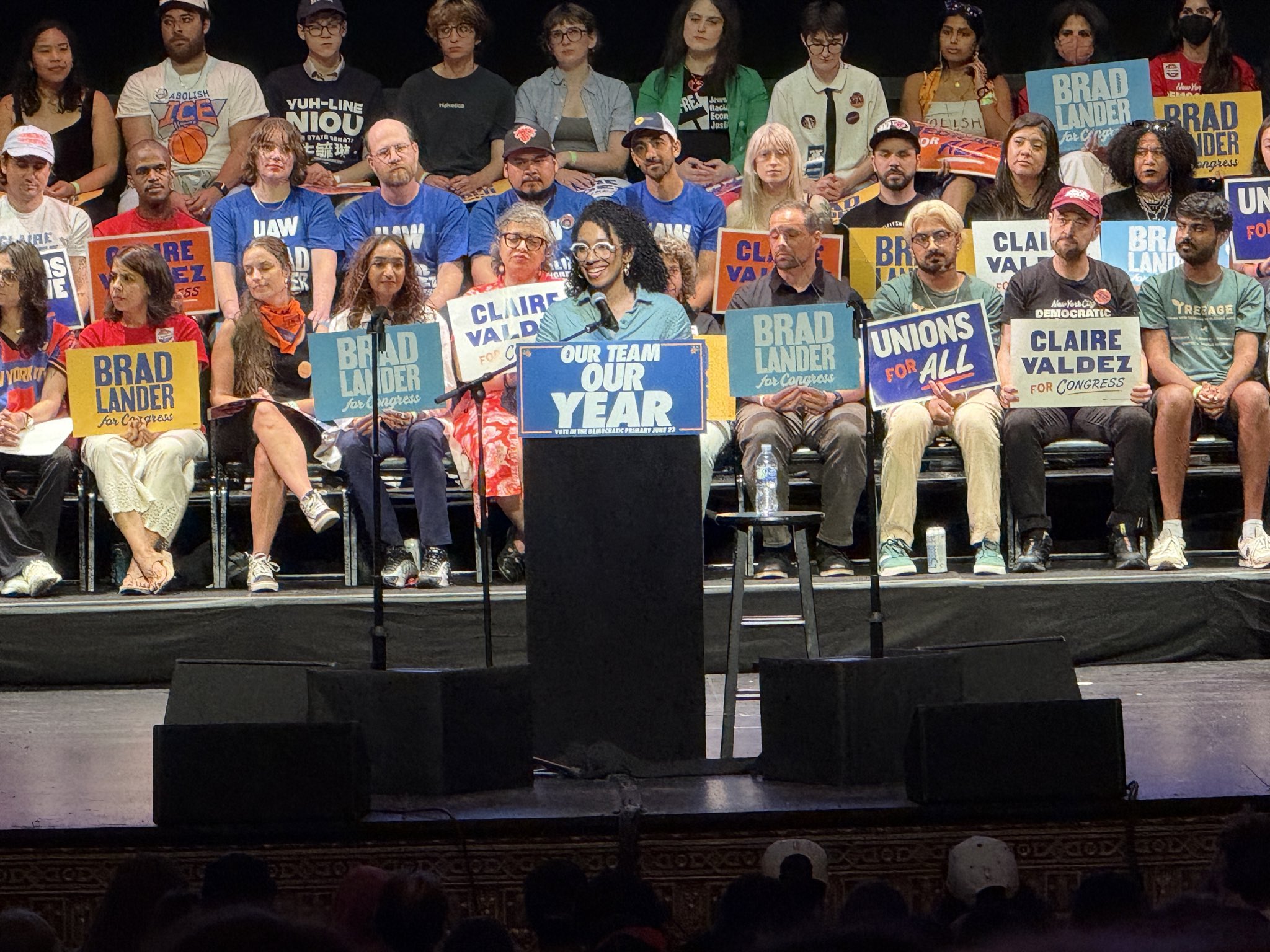
There is however another reason for the recent surge in DSA membership. In the primary elections in New York City (NYC), DSA member Zohran Mamdani emerged as the clear winner of the Democratic nomination for mayor. Going into the primary election campaign, many initially considered Mamdani, a political outsider, as having progressive views too far to the left for the median Democratic voter in the city to be a viable candidate. And yet, by tapping into widespread resentment around an affordability crisis in the city, waging a ferocious campaign led by young organizers fighting for the socialist candidate, and galvanizing support across the city, Mamdani won the Democratic nomination in June.
The NYC chapter of the Democratic Socialists of America played a key role in powering Mamdani’s campaign, offering strategic expertise, organizational infrastructure, and volunteer mobilization. A surge of new members, energized by the prospect of a socialist mayor in NYC, helped amplify that effort. As a result, much of the discussion at the convention, both in formal sessions and informal side conversations, centered on unpacking Mamdani’s success, setting priorities for the November mayoral election, and exploring whether his campaign could serve as a model for similar races nationwide.
Mamdani’s success in NYC is an illustration of a key strategy for DSA in endorsing candidates for office who align with democratic socialist values. Almost 150 elected officials have won with a DSA national endorsement. While it has not settled the debate on electoral vision and strategy within DSA, it has confirmed the utility of endorsing political candidates in Democratic primaries. However, the movement’s growing string of electoral victories is prompting renewed scrutiny of its internal endorsement process, and raising important questions about how to respond when elected officials diverge from DSA members’ values.
One such high-profile case is Congresswoman Alexandria Ocasio-Cortez, arguably the most famous elected official initially endorsed by DSA. However, her endorsement was not renewed by the National Political Committee of DSA, who last year criticized her for what they saw as insufficient support for Palestine. This tension resurfaced last month when Ocasio-Cortez decided not to back an amendment which would have cut off support for Israel’s missile defense system. AOC initially argued that she supported sending “defensive” weapons to Israel. Her vote received a stinging rebuke from DSA. Congresswoman and DSA member Rashida Tlaib also alluded to this controversy during the convention keynote speech in Chicago, when she pronounced “I don’t care what you call or label it – a weapon is a weapon”.
Ultimately, there was a lack of time in a packed schedule to debate a resolution calling for the censuring of Ocasio-Cortez. That resolution will now be taken up by the newly elected National Political Committee. One resolution which was adopted however creates a higher standard for DSA elected officials and members to support the organization’s official positions on Palestine solidarity work. The resolution stipulates that to be a member of DSA or to receive any form of political endorsement, members and potential candidates “….should support the [Boycott, Divestment, and Sanctions] BDS movement, refrain from any and all affiliation with the Israeli government or Zionist lobby groups….” Proponents said this was necessary to make DSA’s position on this issue more unambiguous. Opponents argued that the resolution reflected an inward-looking approach, targeting members rather than building the foundations for a broader anti-war coalition. The question of how, and to what extent, the resolution will be implemented now falls to the many responsibilities of the National Political Committee.
In a bid to restructure DSA’s internal governance, some delegates introduced a “One Member, One Vote” resolution. It argued that the current system that gives delegates the responsibility for electing the organization’s national leadership creates “….structural barriers to participation, and an over-reliance on insider control, limiting the ability of rank-and-file members to shape the organization’s political direction.” Had it passed it would have moved to a system where the entire dues-paying membership of DSA would elect the national leadership committee. Although some saw the resolution as a way to empower the broader membership, it failed to secure the majority needed for passage. Opponents of the change argued that a shift to elections by the whole membership would undermine the deliberative role of conventions, where delegates discuss the organization’s strategy and then choose leaders to carry out that strategy.
During the convention, international delegations from progressive parties, unions, movements, and organizations from across the world were also invited to share their experiences with political struggles and their viewpoints on the biggest challenges to overcome. Recent history has shown that the right was far more effective than the left in unifying and overcoming differences. Reflecting on failures of the past, international speakers emphasized the need to focus on improving the everyday conditions of the working class as the main way to fight fascism. Offering remedies for inflation and the high cost of living, strengthening labor laws and movements, and defending immigrants’ rights were brought up as crucial elements of this strategy.
The defense of immigrants’ rights had wide support amid the worsening conditions and daily raids many migrants face across the U.S. The Trump administration’s recent increase in the annual budget of the Immigration & Customs Enforcement (ICE) agency from approximately $8 billion to approximately $28 billion, as well as dropping the recruitment age limit to 18 years, is a chilling signal of what is to come. DSA committed itself to demanding “….the abolition of ICE and an end to anti-migrant containment strategies both here and abroad, as well as an increase in aid to those fleeing from violence, political and economic turmoil….” The convention made plans to further expand campaigns which offered regular update guidance to citizens and non-citizens about their rights, to facilitate trainings and meetings with legal professionals, as well as to strengthen the ability of cities to protect themselves from ICE.
The push and pull between a more radical approach and a more accommodating approach to mainstream politics and expectations has long shaped the internal dynamics of progressive parties and movements. History suggests that progressive movements have been most effective when they’ve managed to balance this tension. The question now is whether DSA can strike this balance to overcome its internal differences and galvanize itself in the face of rapidly spreading authoritarianism. Can it become a central force in the resistance movement? If urgency and desperation are a catalyst, the outlook should be hopeful.
David Williams directs the Rosa Luxemburg Foundation’s Climate Justice Program in New York.