Double Standards in International Law
Wolfgang Kaleck
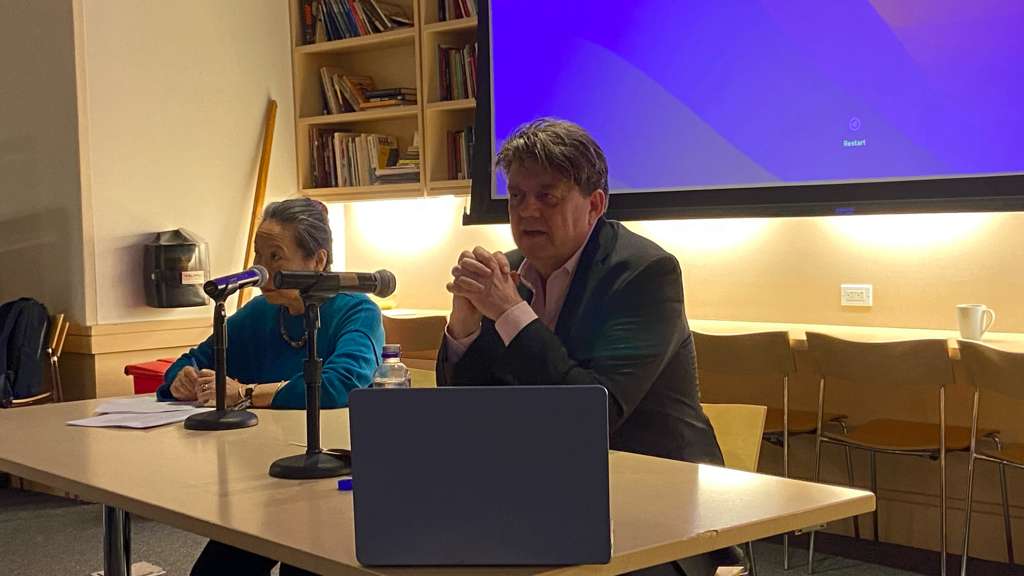
Lecture at the New School in New York City, March 19th, 2025
It is both an honor and a challenge to speak at this institution – a place marked by critical traditions and the intellectual legacy of Hannah Arendt. My remarks aren’t just another critique of the familiar double standards in international law. That’s not enough anymore. The idea of »standards« itself – the shared frameworks that once gave us language for (in)justice – is now at risk. Calling out hypocrisy only works if there’s still common ground to appeal to. But what if that ground is already crumbling?
Those of us who’ve worked in international human rights never saw the legal order as neutral or pure. We understood its deep entanglement with power. But we also had reasons to hope. We could still look to moments like the Nuremberg Trials – not as flawless precedents, but as gestures toward universality. We had Article 1 of the Universal Declaration, fragile as it was, as a reference point.
But the contradictions were never hidden. There was always a structural duplicity at the heart of the postwar order. The same states that celebrated the Universal Declaration of Human Rights were fighting brutal colonial wars. The UK and France, fearing legal exposure for crimes in places like Kenya, Algeria, and the Congo, blocked binding human rights treaties for nearly two decades.[1] This ambivalence is not an aberration, it is constitutive.
When one interrogates the histories of human rights, one finds that popular linear narratives of progress and moral advancement are untrue. Britain’s colonial secretary of state Arthur Creech-Jones called the Declaration »a source of embarrassment«, he wasn’t wrong.[2] He was not wrong – because even as the victorious powers celebrated the defeat of fascism, they refused to relinquish imperial domination. This shows that the project of human rights has always lived between emancipation and control.
To really understand this properly, we have to let go of the idea that history moves neatly forward. The so-called liberal peace was never universal – it was something felt in cities like New York or Berlin, while much of the world lived through war, dictatorship, and mass violence. The U.S., for all its talk of democracy, was directly involved in atrocities from Indonesia to Vietnam, Chile to El Salvador.[3]
But even within the heart of empire, there were those who pushed back. Telford Taylor, a Nuremberg prosecutor, later argued that the principles used against the Nazis should apply to U.S. leaders behind the Vietnam War.[4] In his book Nuremberg and Vietnam, he made a simple but powerful point: if universality isn’t backed by accountability, it’s just ideology.
That’s why legal standards are so much more than documents and treaties. Of course we have the 1948 and 1966 conventions,[5] the prohibitions on torture, on war crimes – but also of the broader ethical and political commitments they imply.
A turning point – at least for my own trajectory – came in 1998 with the arrest of Augusto Pinochet in London. This moment, which I have often described as a moment of awakening, revealed that international criminal law could be mobilized from below and a despot once thought untouchable could be brought to trial.[6]
Spanish prosecutor Carlos Castresana had filed criminal charges against high-ranking Argentine military personnel in 1996 based on the principle of universal jurisdiction, which made possible the prosecution of Pinochet in Spain. Gradually supportive lawyers and exiled Argentine legal scholars joined the proceedings. Relatives of the victims and survivors of torture also began to recognize their own ability to participate in this trial and to initiate similar proceedings. For instance, they provided incriminating material they had gathered during the dictatorship at great personal risk, gave testimonies and filed habeas corpus applications. By doing so they transformed themselves from traumatized objects of totalitarian state violence into procedural subjects and political actors.
Even though Pinochet was released a year later because of his declining health, the case continues to shape the practice of the legal human rights movement today. His arrest was not the result of carefully orchestrated strategy. Rather, it was the product of determined individuals and groups who recognized and seized a political moment. It made the architecture of impunity crack, if only briefly.
This shift from state-centered to grassroots-initiated justice was not simply procedural. It marked a deeper epistemological shift: the law could be reappropriated. It could become a site of rupture. When we, years later, filed legal complaints against Donald Rumsfeld and others for their role in the U.S. torture program,[7] we were not naïve. We knew the chances of success were slim. But the point was never just conviction. The point was to create dissonance in the normative landscape – to force an encounter between power and principle. The stated objective was to communicate, worldwide, a carefully documented record of the systematic torture crimes ordered and carried out by the political, military, and intelligence leadership of the United States, along with a comprehensive legal analysis based on that documentation.
We were told we would destroy the law by confronting the powerful. In fact, the opposite occurred: the powerful took the law seriously. In Europe, at least, the absolute prohibition of torture anchored in international law could be successfully defended in public discourse. The United States’ argument that the abuses at Abu Ghraib were merely isolated incidents attributable to lower-level personnel was effectively refuted. Instead, the responsibility of senior military officials and political leaders has since been demonstrated in numerous articles and academic publications. Donald Rumsfeld avoided travel to Germany. CIA agents were warned not to enter Europe and other regions, where they’d possibly could be prosecuted because of torture. The law, momentarily, displaced impunity.[8]
We’re never on equal footing in these legal battles – not when we go up against states or corporations. They have more money, more lawyers, more tools. So our approach has to be strategic, creative. We can’t romanticize the law, but we shouldn’t dismiss it either. It’s limited – but not useless.
People often criticize our work for focusing on the extremes – torture, disappearances, killings – while the structural injustices of capitalism grind on untouched. And that’s a fair point. It’s hard to file cases against inequality, exploitative trade regimes, or environmental violence. Those systems are built to resist legal scrutiny. They hide behind complexity, loopholes, and fragmentation.
But even with those limits, we find entry points. Certain cases allow us to go further than the case itself – to raise bigger questions, to name broader patterns. That’s what I mean when I talk about a »concrete utopia«.[9] We don’t start from a grand theory of justice. We start from the facts in front of us – five or ten cases a year – and try to turn them into something larger. Not by pretending the law will transform everything, but by using as a tool. To intervene publicly. To shift the discourse – even if only slightly.
It’s not a clean or easy process. But sometimes these legal moves – precise, limited, flawed – become pressure points. They create space where there wasn’t space before. And that’s enough to keep going.
In 2012, more than 250 workers were killed in a fire at a garment factory in Karachi that was producing for a German discount retailer for textiles.[10] That made it possible for us to file a case in Germany and was sufficient grounds to attempt what we might call a »reverse trajectory of globalization« – if capital and control flow outward, legal accountability must be brought back in. When we launched our organization in Berlin, we were clear that our mission would not remain confined to the realm of classical human rights violations – torture, disappearances, political repression. From the very beginning, we reached out to trade unions, to progressive lawyers across Europe and asked them if they would join us in building a structure that also includes economic accountability. At the time, the responses were mixed. Some trade unions reminded us that their members were the very workers employed by these German corporations. Some human rights lawyers, reliant on government funding, were hesitant. Still, it marked an early articulation of what would become our strategic trajectory: to insist that economic and social rights are not marginal, but central to any meaningful understanding of human rights.
In the Karachi-case the development aid and human rights organization medico international called us in, and we sent someone right away. But we didn’t show up thinking we’d bring justice to Pakistan. But from the outset, we knew that the old paternalistic model – where European lawyers would descend with their tools of justice and show others how to act – was neither appropriate nor tenable. If it had ever existed, it had long been discredited by experience. Instead, we listened. Immediately after the tragedy survivors and families of victims established a self-organized association. Local activists and trade unionists told us directly, that they didn’t need saving. What they wanted was recognition, solidarity, and support for the legal efforts they were already pursuing – especially their own criminal cases against the factory owners. So while they negotiated with the company in Pakistan, we filed our civil case in Germany. It was a kind of »good cop, bad cop« approach – they bargained, we pressured. Eventually, the company paid out around five million dollars. Not a huge sum by Western standards, but for the families, it meant visibility, dignity, and some measure of justice. The German case itself didn’t succeed. It was dismissed on technical grounds – statute of limitations. But the impact went beyond the courtroom. Survivors and families gained confidence, formed associations, and found their public voice. One woman who had once stood in front of a camera in tears came back years later as a clear, determined spokesperson for the group. And their presence – on German TV, in public debate – made a difference. The case became a reference point in national discussions about supply chains and corporate responsibility. It helped shift public understanding, not by abstract arguments, but through human stories. That’s what law can do when it’s part of a broader struggle. It creates a stage, a crack in the usual narrative, a chance to say something that might actually be heard.[11]
Things began to shift slowly in that time. Conversations about universal jurisdiction that once felt marginal started gaining traction in the center of politics and society. Amnesty International and Human Rights Watch – organizations that long avoided economic critiques – began to talk about supply chains, due diligence, inequality. Trade unions, once wary, became central players in some of the most forward-looking litigation. And this didn’t happen because powerful institutions had a change of heart. It happened because people kept pushing – lawyers, survivors, grassroots groups – until the center had no choice but to respond. That’s how progress happens in this field. Not by appealing to benevolence, but by creating enough pressure to make ignoring the issue impossible.
Over the past two decades, something remarkable unfolded – mostly outside the spotlight. A new generation of legal practitioners, especially in the Global South, has emerged. Young lawyers – many of them women – working in South Africa, India, Colombia, Pakistan. These lawyers, environmental defenders, and human rights practitioners are not waiting for recognition from Geneva or The Hague. They are not part of a singular legal culture, they are part of a trans-local movement. And through shared networks, shared strategies, and shared risk, we are all part of something larger. And in many ways, that’s where the energy is today – not in big institutions, but in these trans-local formations that blur the line between legal work and political organizing.
But this is happening at the same time that the larger international legal system is eroding. Increasingly, the most powerful states don’t even pretend to follow the rules. Russia tortures without apology. China represses without justification. They don’t bother with the language of legality anymore.
The United States, on the other hand, still speaks that language. After 9/11, when it set up a global torture program, it didn’t say »we’re breaking the law«. It said »this is legal«. That difference matters. Not because hypocrisy is better than honesty, but because when a state still claims to act under law, you have something to hold them to. That’s where critique gains traction. But even that space is narrowing. And the moments that accelerated this closing – Covid Ukraine, Gaza – are all fresh in our collective memory.
Covid ripped away the illusion that international cooperation still functioned. Western countries stockpiled vaccines, refused to lift patents, and let entire regions fend for themselves. It wasn’t just unfair – it was alienating. Even nations aligned with the West began to question what solidarity really meant.
These fractures widened further after the invasion of Ukraine. Western officials expressed bewilderment that many countries in the Global South refused to support resolutions condemning Russia.[12] But how can we demand accountability from Russian leaders without recalling that the 2003 U.S.-led war of aggression destroyed a country, cost up to a million lives, and set in motion countless additional crimes? These are not just rhetorical questions. They go to the heart of the legitimacy crisis facing international law today. Had western leaders acknowledged the memory of Iraq – had they shown any capacity for historical empathy – perhaps things might have played out differently. The failure was not diplomatic, but moral.
And then Gaza. A turning point, not only politically, but epistemologically. Both in Germany and the United States, we have witnessed a growing restriction of civil society space: protests banned, events canceled, funding withdrawn, critical voices silenced. Germany chancellor Germany Friedrich Merz even went as far as saying he – and thereby the German Federal Republic – wouldn’t comply with the ICC arrest warrant against Israeli Prime Minister Netanyahu and his Secretary of Defense. Even within the legal mainstream, there’s backlash to what he said. Serious international law scholars in Germany – people who didn’t support our torture cases back in the day – are now defending the ICC. Conservative lawyers are acknowledging that abandoning legal standards now means, we as a society have nothing to stand on.
Elsewhere, something remarkable happened. South Africa’s filed a complaint against Israel before the International Court of Justice changed the global conversation.[13] People across the world watched, not because they believed the ICJ would resolve the conflict, but because the act itself – filing that case – shattered the illusion that only Western states could invoke international law. It shifted the paradigm.
South Africa’s case before the ICJ wasn’t just a legal filing – it was a break in the choreography. For decades, the actors who invoked international law with authority were overwhelmingly Western. South Africa flipped that script. It brought the law forward not as an abstract ideal, but as a weapon of the historically excluded. Of course, South Africa’s own role in international politics is complex. Its leaders were once among the most vocal critics of institutions like the ICJ, calling them neo-colonial.[14] And they weren’t wrong. Despite that history, they used the court. Not to perform legitimacy, but to test it.
The same is true, to a lesser extent, with other BRICS countries. Many of them were long critical of the international legal system. But now we’re seeing some of them begin to engage, to invoke, even to litigate. That doesn’t mean BRICS offers an alternative legal vision. It doesn’t. There is no progressive consensus there – just tactical overlaps and temporary coalitions. We can work with that, but we shouldn’t mistake it for alignment. We don’t share politics. We share moments. But even those moments matter. Because they signal that the monopoly on legal authority is breaking. The stage is no longer reserved for former colonizers and military alliances.
But the erosion of old monopolies does not guarantee a more open world. One of the most urgent threats we face today is the shrinking of civic space. This does not always take the form of overt repression. It is not always about assassinations or imprisonment. It is often bureaucratic. Revoking the legal status of NGOs, criminalizing foreign funding, denying permits, demonizing dissent. This, too, is an authoritarian playbook, but make no mistake: it is already well advanced, both in Germany and other western states as well. Critical voices are more easily dismissed, or silenced through process, not force. It’s less visible, but just as damaging.
The fragile platform that once allowed smaller states like Vanuatu, Tuvalu, or Liechtenstein to bring cases – on climate, on oceans, on global justice – that platform is shrinking. And if that space disappears, it won’t just be governments that lose access to international law. It will be all of us who operate from outside the centers of power. For years, we relied on that sliver of space where NGOs, survivors, and non-Western actors could challenge the hierarchy. That space didn’t guarantee success – but it made change possible. And now, unless we defend it actively, it may close for good.
It’s not just civic space that’s shrinking. The institutions themselves – the ones we once relied on to create minimal accountability – are being hollowed out. The United Nations isn’t just under rhetorical attack. It’s being starved. The U.S. has always had a complicated, often hostile relationship with the UN system. But now, European states – Germany, the UK, even the Nordics – seem more focused on humanitarian branding than on actually defending legal infrastructure.
They still fund aid projects. They still deliver speeches on the importance of human rights. But when multilateral institutions are under siege – when courts are targeted, when agencies are defunded – they rarely step in. They don’t want a fight. And without a fight, those institutions won’t survive. The International Criminal Court is already under renewed pressure. Not just politically, but legally and financially. Sanctions are back on the table – led by the same states that once insisted the ICC was essential. Whether these sanctions will be effective is still an open question. But it’s not a strategy to hope the machinery of repression trips over its own wires.
This moment demands clarity. What we have long tried to do – what we did in the Rumsfeld and Pinochet cases and elsewhere – is to apply international law in one case, then attempt to universalize that application. To say: this precedent is not exceptional, it is normative. But when those in power withdraw from that logic – when they create mechanisms that are explicitly partial, then discard them when they no longer serve – the entire normative structure begins to fracture. This isn’t a return to Kissinger-style realpolitik. It’s something more blunt. Less masked. The New York Times this year called the U.S. foreign policy orientation as »Neanderthal realism«[15] – a term that feels dramatic, but sadly accurate. It’s the normalization of power as justification. The end of even pretending to follow a shared framework.
And while that’s happening, something else is slipping. Many people are withdrawing from legal engagement, dismissing the entire field as co-opted, as compromised beyond repair – that legal work is just decoration for broken systems.
A number of German legal scholars today argue that the erosion of legal protections, didn’t just come from the Right. It was made easier because the Left stopped showing up. It stopped contesting the terrain. And into that »silence«, bad laws took root.
Perhaps it is already too late in some arenas – but probably it isn’t. And in any case, that would be the wrong approach. What matters is whether we can begin again – not with naïveté, but with clarity. The rule of law, the universality of human rights, the architecture of international law: none of these should be left to authoritarians, or to technocrats, or to the philanthropic elite. They must be contested, yes – but also defended. They must be reconstructed, not only deconstructed. We need to hold both positions at once. We can be radical critics of the international legal order – feminist, decolonial, marxist – and still defend what remains of it from collapse. Defending the rule of law doesn’t mean defending legal formalism. It means defending it core principles – dignity, accountability, rights – that give the law its content. Without that, it’s just process. We can expose its hypocrisies while demanding its democratization. We can mourn its failures and still fight to make it real. Because if we don’t, someone else will.
And they won’t use it to protect rights. They’ll use it to shut them down. Courts can be captured. We saw it in the U.S. with Trump’s appointments. We see it in Europe too. The European Court of Human Rights now includes judges nominated by far-right governments. We had a case on pushbacks at the Spanish-Moroccan border. We won in the first round. Then the composition of the court shifted, and we lost on appeal. Same law, same facts, different politics.
Eyal Weizman’s work with Forensic Architecture reminds us of the Roman origin of the term »forensics«: forum. The forum was not the courtroom. It was the public square. And forensics, in its original sense, referred to the presentation of contested facts for public deliberation. That is a powerful image for what legal work should aspire to today. We need networks. Legal workers, artists, survivors, organizers. We each do our part. A case doesn’t just live inside a file. It lives in how we talk about it, how we organize around it.
This is the core proposition – that we move beyond critique. That we use what legal space remains – however compromised – to build something better. That we create access to law as a shared resource, not a privilege. That we stay in the fight, not out of faith, but out of necessity.
[1] For further reference see: Kaleck, Wolfgang: Concrete Utopia – Looking Back into the Future of Human Rights, 2024, Chapter II.
[2] In a confidential circular sent to the British colonies in 1949, Arthur Creech-Jones (Britians Secretary of State for the Colonies), described the Universal Declaration of Human Rights as a potential »source of embarrassment«; for further reference see: Klose, Fabian: »Source of Embarrassment« – Human Rights, State of Emergency, and the Wars of Decolonization, in Hoffman, Stefan-Ludwig (ed.): Human Rights in the Twentieth Century, p. 242, fn. 30.
[3] See also: Kaleck: Concrete Utopia, Chapter II.
[4] Taylor, Telford: Nuremberg and Vietnam – An American tragedy, 1971.
[5] The Universal Declaration of Human Rights was declared in 1948, the International Covenant on Civil and Political Rights (ICCPR) and the International Covenant on Economic, Social and Cultural Rights (ICESCR) in 1966.
[6] For further detail, see: Kaleck: Concrete Utopia, Chapter VII.
[7] In 2004, the Center for Constitutional Rights and I filed criminal complaints against Rumsfeld and others, in Germany and the USA, because of their connection with war crimes, torture and other criminal acts which took place in the military prisons of Guantánamo and Abu Ghraib; for further information see: European Center for Constitutional and Human Rights: The Rumsfeld Torture Cases (available at: https://www.ecchr.eu/en/case/rumsfeld-torture-cases/).
[8] See also, in greater depth on the Torture Cases: Kaleck: Concrete Utopia, Chapter VII.
[9] The idea of the »concrete utopia« of human rights is discussed in my Book: Concrete Utopia (fn. 1).
[10] For detailed information on the case see: European Center for Constitutional and Human Rights: KiK – Paying the price for clothing produced in South Asia (available at: https://www.ecchr.eu/en/case/kik-paying-the-price-for-clothing-production-in-south-asia/).
[11] For further elaboration on the Karachi-Case see: Kaleck: Concrete Utopia, Chapter VII.
[12] For example: All states abstaining or voting against the March 2022 UN-General-Assembly-Resolution (A/RES/ES-11/1) that condemns Russia’s invasion of Ukraine were countries in, Latin America, the Middle East, Africa and Asia, which sparked criticism in Europe.
[13] On the 29th of December 2023 South Africa filed an case against Israel before the International Court of Justice, concerning alleged violations by Israel of its obligations under the Convention on the Prevention and Punishment of the Crime of Genocide; for further information see: https://www.icj-cij.org/case/192.
[14] See Mude, Torque/Maramura, Tafadzwa/Justinu, Avelinu: International criminal law and the neo-colonial contract – Africa’s quagmire and prospects for sustainable decolonisation, 2024, p. 57 et seq, for a comprehensive historical analysis (available at: https://edoc.hu-berlin.de/server/api/core/bitstreams/cc95623b-9528-437b-9bb9-4e8d1d70e71f/content).
[15] Stockman, Farah: Trump’s Foreign Policy May Be Crude, but It’s Realist, New York Times, March 7th, 2025.
Wolfgang Kaleck is a leading German lawyer and human rights activist who has spent more than two decades involved in the global struggle to hold powerful people and governments accountable for abuses. He is the founder of the European Center for Constitutional and Human Rights in Berlin.