Labor Notes 2026: Notes from the Largest Gathering of Worker Organizers in the United States
Aaron Niederman
It was at the Rosa Luxemburg Stiftung’s Streikkonferenz in May 2025 that I first encountered Labor Notes as something more than a publication. Through Keith Brower Brown’s presentation on the revival of militant unionism in the United States and the emergence of a viable opposition to Donald Trump in the absence of meaningful Democratic resistance, I caught a first glimpse of the much larger organizing ecosystem surrounding it. I had been reading Labor Notes for years, but the scale and ambition of the project behind the magazine remained almost impossible to grasp from afar.
A year later, attending the biannual conference in Chicago made clear just how extensive that organizing infrastructure has become.
If, like I was, you’re somewhat unfamiliar with Labor Notes, it is best understood as a media and organizing project founded in 1979 by labor activists and socialists amid deindustrialization, concession bargaining, and widespread frustration with bureaucratic union leadership. Since then, its mission has remained remarkably consistent: to connect worker activists, develop organizing skills, strengthen rank-and-file democracy, and cultivate a labor movement willing to challenge employers and, when necessary, its own leadership. Through its magazine, books, workshops, and conferences, Labor Notes has become one of the most influential institutions of the American labor left, dedicated to what many participants describe simply as “putting the movement back in the labor movement.”
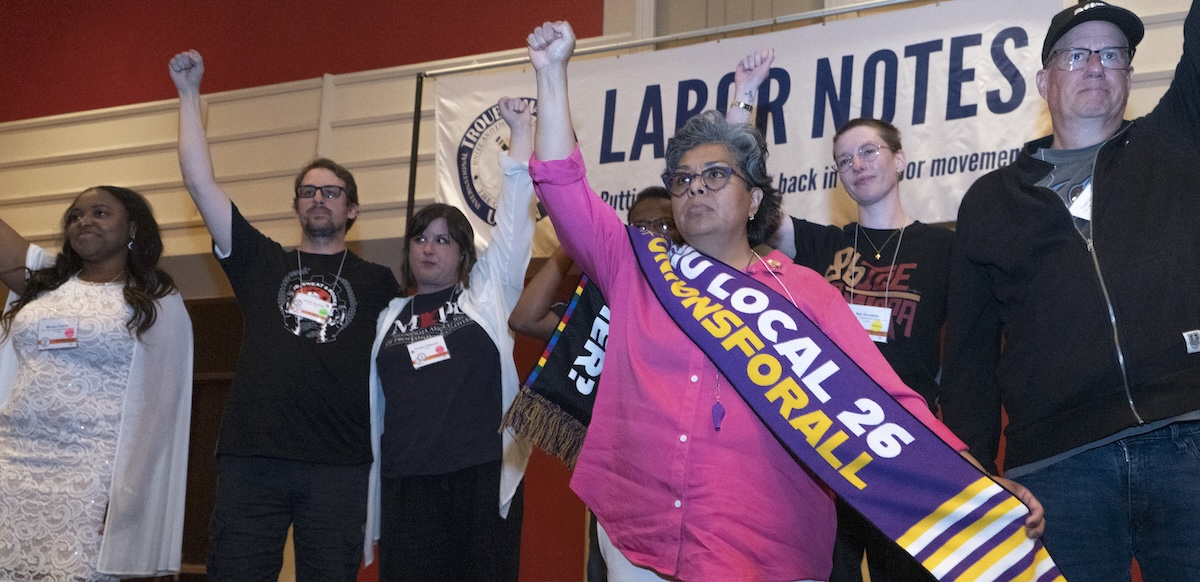
Last month,, Labor Notes brought together roughly 4,700 rank-and-file members, staff organizers, and labor activists from across sectors for what was its largest conference ever. The conference takes place every two years in Chicago and has grown to such a scale that organizers reportedly left more than 1,000 people on the waitlist and indicated that they were exploring larger venues for future conferences.
Labor Notes has also increasingly become an international project. I learned that they have hosted a regional Labor Notes Asia conference in Taiwan and organizers also spoke of partnerships with a Japanese Labor Union College and the emergence of Troublemaker Schools in Spain and elsewhere. Labor Notes is increasingly functioning as both a U.S. publication and conference as well as a transnational organizing infrastructure still in the process of being built.
Given thatLabor Notes was such a huge conference—with more than thirty-five simultaneous streams of programming—my goal with this recap is not to be exhaustive. Instead, I want to highlight some of the hot-button issues, internal debates, and moments that felt especially eye-opening. My hope is simply that it creates a useful jumping-off point for further research and action.
Union Reform Caucuses and Democratic Renewal
One of the conference’s central themes was the development of what Americans call union reform caucuses.
These formations are particularly significant in the United States because many unions directly elect national leaders and because rank-and-file opposition formations have repeatedly transformed entire unions from below. In Germany, by contrast, national union leadership structures are generally more centralized, officers are often not directly elected by the entire membership, and dissident currents have historically expressed themselves through works councils, shop steward structures, local opposition lists, and broader left networks. As a result, reform caucuses are far less common.
For decades, Labor Notes has acted as an incubator and meeting place for these efforts where caucuses function not simply as opposition slates but as laboratories for democratic renewal, generation of new organizing strategies, media infrastructures, political education projects, and networks of worker-leaders.
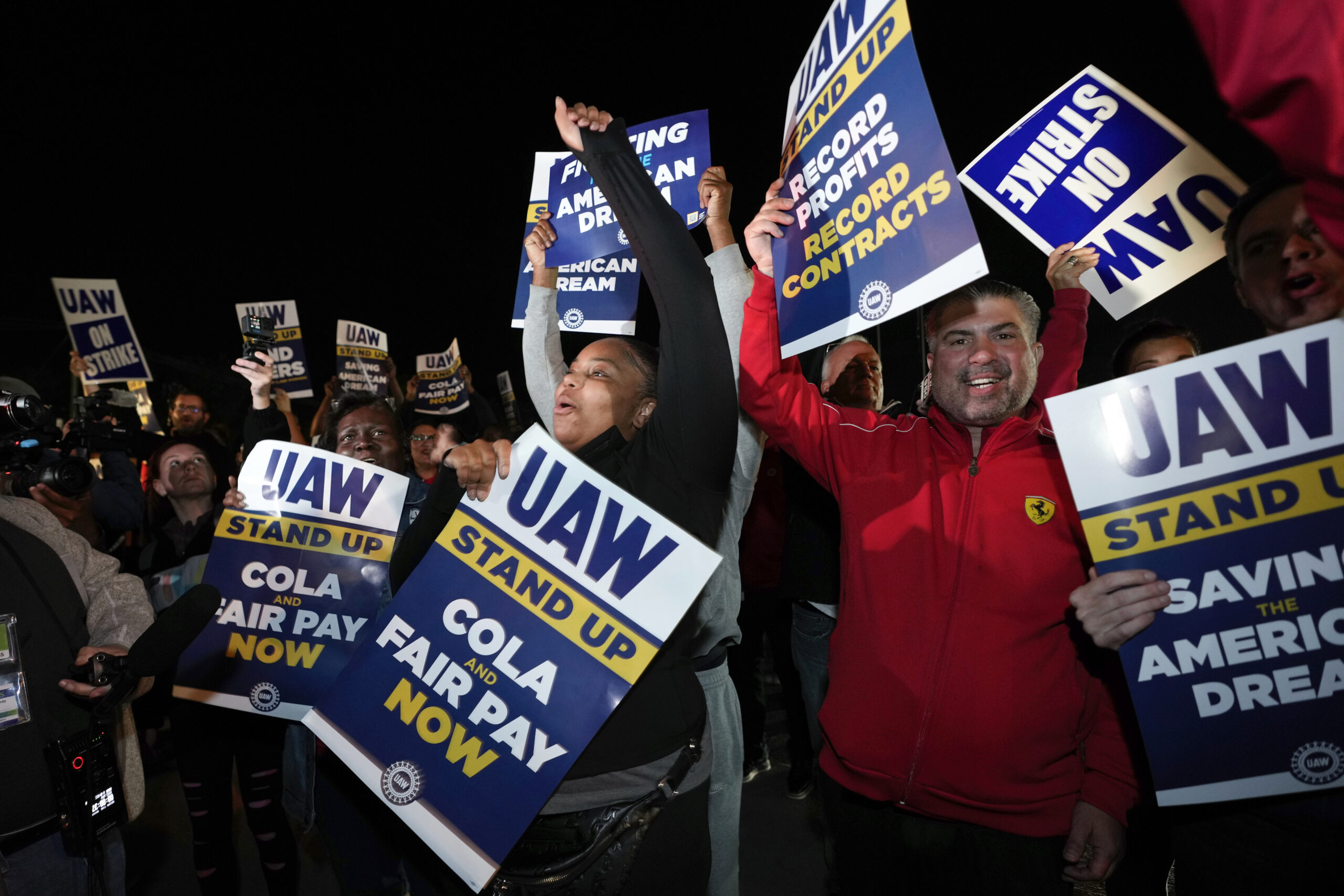
This work became especially visible in recent years when the reform caucus United Auto Workers for Democracy (UAWD) helped win a new rule to mandate direct elections for top UAW leadership through its One Member, One Vote campaign. The reform caucus subsequently played a pivotal role in electing Shawn Fain as president of the union. Labor Notes has since compiled much of its experience in the extremely useful guide How to Build a Union Reform Caucus and its accompanying flow chart.
As the packet itself suggests, however, caucuses are complicated and often contradictory.
The now fifty-year-old Teamsters for a Democratic Union (TDU) helped democratize the Teamsters and played a decisive role in bringing reform leadership to power. Yet it has since found itself in a complicated relationship with the new union leadership led by Sean O’Brien. O’Brien has cultivated unusually close relations with Donald Trump, including speaking at the Republican National Convention, supporting Trump’s nominee for secretary of labor, and embracing elements of his tariff agenda. These moves have deeply unsettled many labor militants and contributed to the emergence of new oppositional currents such as Teamsters Mobilize.
Just last year, after the Steering Committee recommended dissolution, a majority of UAWD members voted to dissolve the caucus. The split reflected disagreements over its relationship to the Fain administration, internal democracy, and the role of broader political issues in its organizing. Supporters went on to launch UAW Member Action, focused on workplace organizing and contract campaigns, while opponents continued organizing as UAWD and through The Daily Struggle, arguing that the dissolution required a two-thirds majority under the caucus’s bylaws. They have since continued building local chapters and organizing around Palestine, helping win a UAW convention resolution calling for the union to divest its holdings in Israel bonds.
Taken together, the experiences of both TDU and UAWD point toward a recurring dilemma for reform caucuses after victory. Once reformers win leadership, should these caucuses become governing partners or remain independent organizing formations? And how can they preserve the rank-and-file energies that brought them to power in the first place?
Taking on Amazon
Another major topic of conversation at Labor Notes was Amazon. As labor writer Jonathan Rosenblum recently put it, “Amazon is today’s General Motors. What happens to Amazon workers—good or bad—will happen to workers everywhere.” One of the Amazon sessions, “Taking on Goliath: Tactics to Bring Amazon to Heel,” reflected that sense of strategic importance. Workers from North America and Europe discussed union elections, independent unions, direct action, shop-floor organizing, and strikes across the company’s sprawling logistics empire.
The discussion oscillated between global and local perspectives. Organizers detailed how they are building power across fulfillment centers, delivery stations, air hubs, and subcontracted delivery networks while repeatedly calling for greater international coordination and, eventually, strikes across global supply chains, including through networks such as Amazon Workers International (AWI).
Some of the most innovative strategies came from Spain. In one action, workers reported to work as normal and waited until peak production periods before walking out. The action delayed more than forty trucks and had a significant operational impact. Rather than simply withdrawing labor, workers withdrew it at precisely the moment when the company was most vulnerable. It was a powerful reminder that creativity and strategic timing can sometimes matter as much as numbers and that one challenge is how to scale such efforts.
More than any single tactic, it was the opportunity to compare experiences across countries that stood out. One Labor Notes organizer described Labor Notes as the largest-ever gathering of Amazon workers and organizers, with more than 250 participants in attendance. Overall, the gathering revealed both the impressive growth of transnational Amazon organizing and the fact that much of the organizing infrastructure needed to sustain it remains a work in progress.
May 2028 and New Seasons of Class Struggle
The call to organize national strikes and contract fights around May Day 2028 — originally proposed by the UAW and Shawn Fain in 2023 — was another recurring topic throughout the conference.
The panel “From May 2026 to May 2028: Seasons of Class Struggle” reflected on the nearly one-million-person mobilization in Minnesota on January 23—a “No Work, No School, No Shopping” strike and day of action demanding that U.S. Immigration and Customs Enforcement (ICE) leave the state—as well as the various May Day mobilizations that brought tens of thousands into the streets across the country.
The panel also explored how unions are attempting to align contract expirations and build momentum toward possible large-scale strike actions in May 2028. This will be critical to making Fain and the UAW’s call from 2023 a reality. The very fact that such conversations are occurring at all feels notable. The idea of coordinated, cross-sector strikes on a national scale still appears improbable, yet it occupies the strategic imagination of significant currents within the American labor movement.
International Solidarity and Strategic Debates
Other notable sessions focused on international solidarity.
Organizers from Workers’ Initiative (Inicjatywa Pracownicza) in Poland discussed their global organizing forums and cross-border strategies. Participants from the International Transport Workers’ Federation (ITF) and Micelio ROJO—a Mexican multidisciplinary organization founded in 2024 to support independent and democratic labor movements—also explored possibilities for international collaboration.
Audience interventions were often strikingly critical. Several participants explicitly characterized the AFL-CIO’s Solidarity Center — the U.S. labor federation’s international organizing arm — as an extension of U.S. foreign policy and imperial power, with some even calling for its dissolution altogether. Criticism of the Solidarity Center was nearly unanimous. The debate lay less in diagnosing its history than in imagining what alternative forms of international labor solidarity should replace it.
Networks, Institutions, and Emerging Currents
The various meetups surrounding the conference also revealed the strength and diversity of the Labor Notes ecosystem.
Gig worker organizing was a recurring theme. Recent legislative victories by Taiwanese delivery workers suggested how even relatively small but militant minorities can compel political change, while debates over Uber organizing in the United States revealed competing theories about whether reforms build or undermine worker power.
Tech workers were present in especially high numbers. A meetup of more than one hundred participants—organized largely through the Tech Workers Coalition and the Communication Workers of America—discussed efforts to organize the technology sector and build collective responses to artificial intelligence and workplace surveillance. Many participants looked toward the upcoming Circuit Breakers conference in New York as an important next step.
The Democratic Socialists of America and its allies with the Emergency Workplace Organizing Committee were also highly visible. Their after-party drew hundreds of participants and was full of stories of recent successes: continuing efforts to recruit salts (activists who get jobs to support organizing from within a workplace) via job fairs, support for an organizing campaign at Wells Fargo, and the recent successful campaign against Avelo Airlines after the company contracted with ICE to conduct deportation flights.
Aside from these more explicitly political and sectoral groups, the conference also highlighted the remarkably heterodox nature of theLabor Notes milieu.
Long Haul Magazine and Notes from Below co-hosted a social event that was literally spilling out onto the streets of Chicago. The enthusiasm surrounding the gathering suggested a renewed appetite for traditions that emphasize workers’ inquiry and changing forms of work and class composition.
Jane McAlevey and Alternative Organizing Traditions
Personally, coming from the German context—where the late Jane McAlevey’s work has profoundly shaped contemporary organizing discussions and where she remains deeply admired—I was surprised to encounter such thoughtful, respectful, and open engagement with the limitations some organizers perceive in her methods.
Generally, people committed to Labor Notes frequently pointed toward books such as Secrets of a Successful Organizer, A Troublemaker’s Handbook, and Ellen David Friedman’s newly published Keep Going: A Guide to Organizing When It’s Hard as important organizing manuals. Friedman herself suggested that the book reflects on some of the limitations and challenges that emerge in organizing practice.
More specifically, in conversations with several longtime Labor Notes organizers, some argued that aspects of McAlevey’s approach can be overly formulaic and too centered around staff organizers, and, in certain applications, even “coercive.”
One seasoned organizer argued that McAlevey’s emphasis on agitation can sometimes stir emotions that are not productive for organizing and that highly structured organizing conversations geared toward securing concrete commitments can make it difficult for workers to say no. They noted that some organizers using these methods had even found coworkers beginning to avoid them as a result.
Many of these critiques drew—implicitly or explicitly—from traditions associated with Myles Horton, Ella Baker, and Paulo Freire, emphasizing collective political development, popular education, and relationships as spaces for collective learning and democratic self-activity rather than simply vehicles for securing commitments. One organizer further argued that an overemphasis on individualized one-on-ones risks obscuring Marx’s understanding of human beings as fundamentally social and relational creatures whose political development emerges collectively.
It was also striking to see how internationally these traditions and debates now circulate: comrades from Japan noted that they had recently translated one of Myles Horton’s works into Japanese. Whether one agrees with these critiques or not, they opened up lines of thought and traditions of organizing that are often less visible in German labor organizing discussions.
AI and an Open Strategic Question
In such a large conference, it is easy to miss things.
To be fair, I only attended one of three AI-related sessions. The conference featured workshops on AI and job quality, bargaining around technology, and the semiconductor supply chain. In the bargaining session, participants highlighted the UC Berkeley Labor Center’s impressive Negotiating Tech database, which catalogs hundreds of technology-related provisions from collective bargaining agreements and offers unions concrete tools for responding to technological change.
Yet from my vantage point, these discussions still appeared relatively fragmented. Rather than a coherent strategic narrative around AI, I encountered a series of sophisticated but largely defensive and sector-specific responses centered on bargaining, protections, and mitigation. The issue seemed to be in formation, but a shared orientation toward how labor movements might shape, govern, or contest AI itself had not yet fully emerged.
As someone currently researching AI and labor organizing, this absence was perhaps one of the conference’s most striking—and somewhat sobering—findings.
What Stayed With Me
Some participants remarked that previous conferences had felt more euphoric and buoyed by recent strike victories. This year felt somewhat different. There was urgency in the air.
And yet, it wasn’t the massive thousand-person plenaries that have stayed with me most. It was the conversations: with longtime railroad unionists, teachers, Amazon logistics workers, tech workers, delivery drivers, and people trying to organize all sorts of seemingly impossible workplaces—new nonprofits, remote workers, and organizing in “green fields” where unions scarcely exist. I met graphic designers and software developers employed by unions and people whose job descriptions I still struggle to explain in so few words. The sheer diversity of experiences, skills, and political traditions was staggering. Yet there was also a sense that all of these currents—some old, some entirely new—were somehow converging.
It felt like I was watching the future of the labor movement in the making—a hopeful suspicion that these methods, these struggles, and these people are building exactly the kind of power we need, and that one day we will look back on gatherings like this as milestones on the path toward a world that today still feels impossible.
If there was one thing Labor Notes made clear, it is that such a world will not emerge spontaneously. It is being patiently assembled through conferences, caucuses, publications, schools, friendships, and the countless relationships through which workers come to recognize themselves as part of something larger.
Aaron Niederman is a researcher and organizer from Chicago, now based in Berlin. They are a PhD fellow of the Rosa Luxemburg Foundation researching the use of AI and digital tools in labor organizing.
This article is part of Rosa Luxemburg Foundation’s ongoing series of reports from the Labor Notes conference. You can read the last conference’s report, “Trade Union Conference on the Move,” here: Trade Union Conference on the Move.
Photo: Joe Brusky/Labor Notes