New York’s Democratic Socialists Flex Their Muscles
Nick French
When thirty-four-year-old democratic socialist Zohran Mamdani won New York City’s mayoral race last year, his election was often described as a “political earthquake.” If the metaphor is apt, then the city’s Democratic primaries this week were a series of powerful aftershocks.
In a decisive show of strength for the city’s socialist movement, on Tuesday two congressional challengers backed by Mayor Mamdani and the New York City chapter of the Democratic Socialists of America (DSA) scored victories against erstwhile Democratic Party power brokers. In the Seventh Congressional District, covering western Queens and northern Brooklyn neighborhoods, State Assembly Member Claire Valdez won in a landslide against Brooklyn Borough President Antonio Reynoso, who had the support of outgoing Rep. Nydia Velázquez and the local progressive establishment. And in Upper Manhattan’s Thirteenth District, Darializa Avila Chevalier narrowly knocked off five-term incumbent and Congressional Hispanic Caucus chair Rep. Adriano Espaillat.
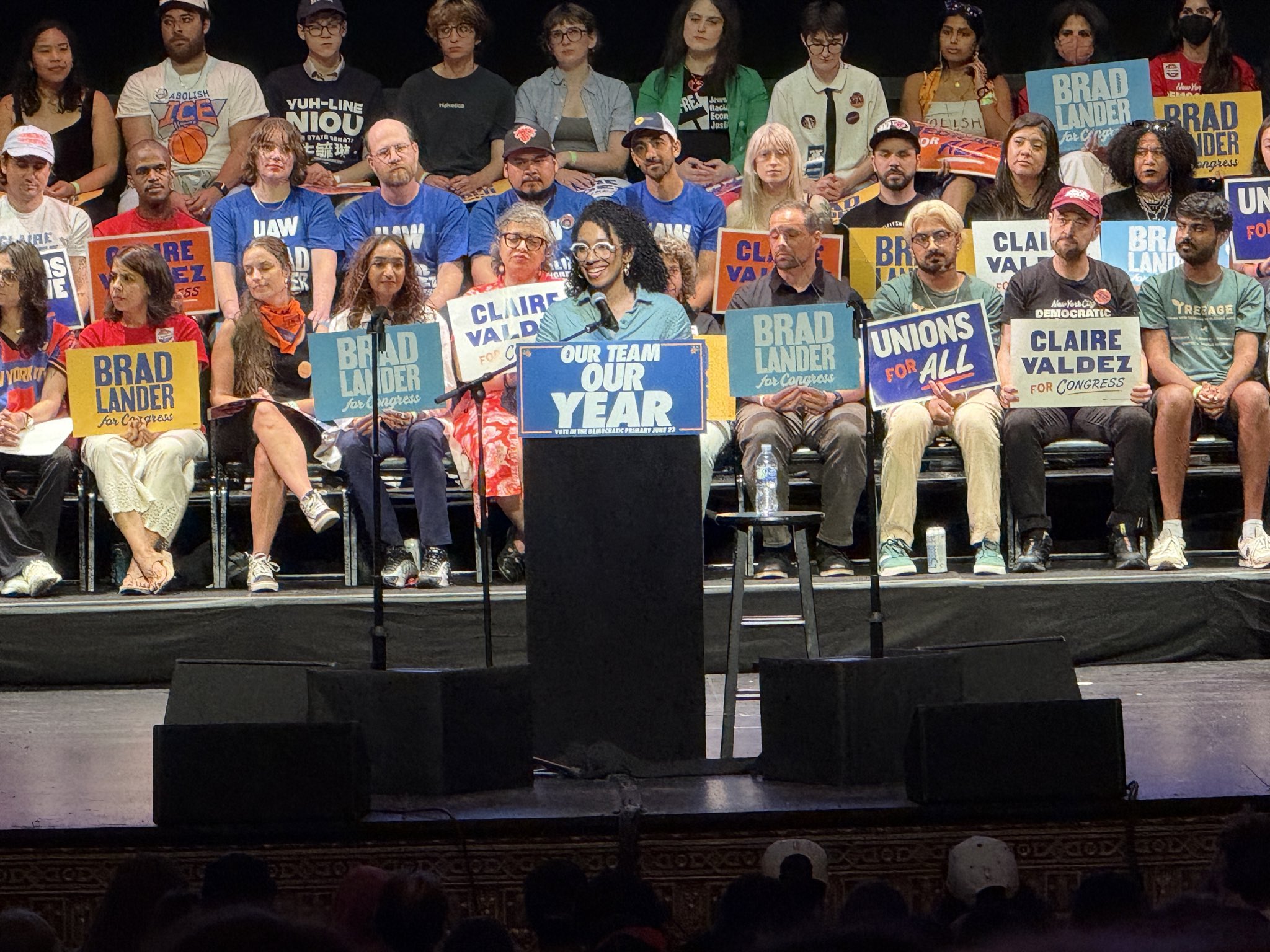
Those weren’t the only significant victories for the Left. In the Tenth Congressional District, former city Comptroller Brad Lander, also endorsed by the mayor, handily defeated incumbent Rep. Dan Goldman in a race that became a referendum on the United States’ relationship with Israel. And downballot, NYC-DSA won six out of seven elections of challengers for the state legislature. Counting incumbents as well as socialists elsewhere in New York State, at least fifteen socialists will be heading to Albany next year. That includes Adam Bojak from the Buffalo area, who also won his assembly primary on Tuesday; in Syracuse, Maurice Brown’s race is still too close to call, but if his lead holds then socialists will hold sixteen seats in the state legislature. (Since all the DSA candidates’ primaries were in districts that lean heavily Democratic, their victories in the general election are more or less assured.)
A Decisive Victory
Tuesday night was the culmination of several high-stakes conflicts that have wracked New York Democrats this campaign season. With his early endorsement of Claire Valdez for Velázquez’s open seat, Mamdani earned the ire of the veteran Puerto Rican American congresswoman, who had hoped to choose her own successor; she backed Borough President Reynoso for the seat in defiance of the mayor. And when, about a month before the election, Mayor Mamdani endorsed Darializa Avila Chevalier — going back on campaign-trail assurances to incumbent Rep. Espaillat that he would not endorse a challenger — he was picking another big fight with the local Democratic establishment.
These races, as well as Lander’s challenge to Goldman and DSA’s state-level campaigns, highlighted long-running divisions within the Democratic Party coalition. Israel’s grotesque human rights violations in Gaza, and the question of the Israel lobby’s influence on US politics, were a major part of the story. The Israel lobby unleashed a flood of campaign cash in support of Goldman, Espaillat, and others in an attempt to defeat vocal left-wing pro-Palestine candidates. A similar strategy seemed to work for them in 2024, when AIPAC-backed challengers unseated democratic socialist Congress members Jamaal Bowman and Cori Bush.
This week’s primary also underscored the continued divide between emergent socialist left and organized labor. Despite running on an ambitious pro-labor policy platform and coming out of the labor movement herself, for instance, Valdez only garnered a few endorsements from local labor unions, while the vast majority backed her opponent, Reynoso. UAW Region 9A, in which Valdez was a longtime organizer and which has been run by left-wing leadership since a reform effort took over the international union in 2023, was a notable exception to the trend; it endorsed her campaign as well as those of Chevalier, Lander, and progressives and socialists downballot.
Yet the combined forces of AIPAC money, risk-averse unions, and local Democratic grandees were no match for Mayor Mamdani and DSA.
The near-sweep by Mamdani- and DSA-endorsed candidates led the New York Times to dub the mayor a “kingmaker.” But there are a few other takeaways worth emphasizing. NYC-DSA has shown itself to be a durable and increasingly powerful political machine, notching more election victories cycle after cycle, and proving its ability to do so on an ever-larger scale. Meanwhile, the Israel lobby’s influence on the electorate appears increasingly tenuous or even negative, as pro-Palestine candidates made opponents’ support for Israel or ties to pro-Israel donors a political liability.
The institutional heft of Democratic Party leaders like Espaillat and Velázquez and their loyal union backers was shown to be built on sand. Their attempts to mobilize voters were positively feeble in the face of the mayor’s star power and DSA’s fierce door-knocking operation; for risk-averse union leaders in particular, Reynoso’s humiliating loss ought to be a wake-up call.
The primary also seemed to sound the final death knell of one of establishment Democrats’ favorite weapons against the Left. As Hillary Clinton did against Bernie Sanders in 2016 and centrists have tried again and again since, Reynoso, Espaillat, and their allies deployed identity politics to attack their opponents. The favored line of attack this time around was that socialists were just a bunch of wealthy white transplant gentrifiers attempting to impose their rule on rooted, black and brown working-class communities. (For Chevalier, who is Afro-Latina, this messaging happened alongside racist efforts to cast doubt on her Dominican heritage.) These identitarian appeals fell flat.
What’s Next?
The victories have serious practical implications for the Left going forward. In New York, they strengthen Mayor Mamdani’s hand in future efforts to pass his affordability agenda, giving him more allies in the state legislature and a greater ability to credibly threaten opponents of that agenda. More generally, the wins show beyond a shadow of a doubt that socialists are an electoral force to be reckoned with — one that moderate Democrats ignore or attempt to marginalize at their peril.
But Tuesday’s results have national implications too. Mamdani and the Left now have a claim to represent the heart of the Democratic Party’s base. To solidify that claim, socialists and their allies may need to prove they win outside deep-blue districts; in that regard, DSA member Francesca Hong’s bid for Wisconsin governor is an important test, as are the campaigns of pro-labor, left-populist Senate candidates like Graham Platner in Maine and Dan Osborn in Nebraska. And the Left will certainly need to scale up its electoral wins even further, and build greater organizational capacity outside of the state — including in the labor unions that have mostly kept it at arms length — if it is to enact the ambitious policies that congresswomen-elect Valdez and Chevalier are championing.
But right now, Mamdani and DSA can undoubtedly make the case that their faction is on the rise and is offering something to voters that the Democratic old guard appears unable to deliver. This dynamic may in turn set up a real intraparty contest when it comes time to pick a presidential nominee in 2028. The Left still has to converge on a national standard-bearer, of course. The meteorically ascendant “kingmaker” Mamdani was not born in the United States and so is not constitutionally eligible to run for president. The name on many people’s minds is that of the congresswoman who, nearly a decade ago, inaugurated New York City’s socialist renaissance with her own political earthquake: Alexandria Ocasio-Cortez.
Nick French is an associate editor at Jacobin.
Top photo: Kelly Mena