Public Supermarkets Under a Socialist Government
Bryce Covert
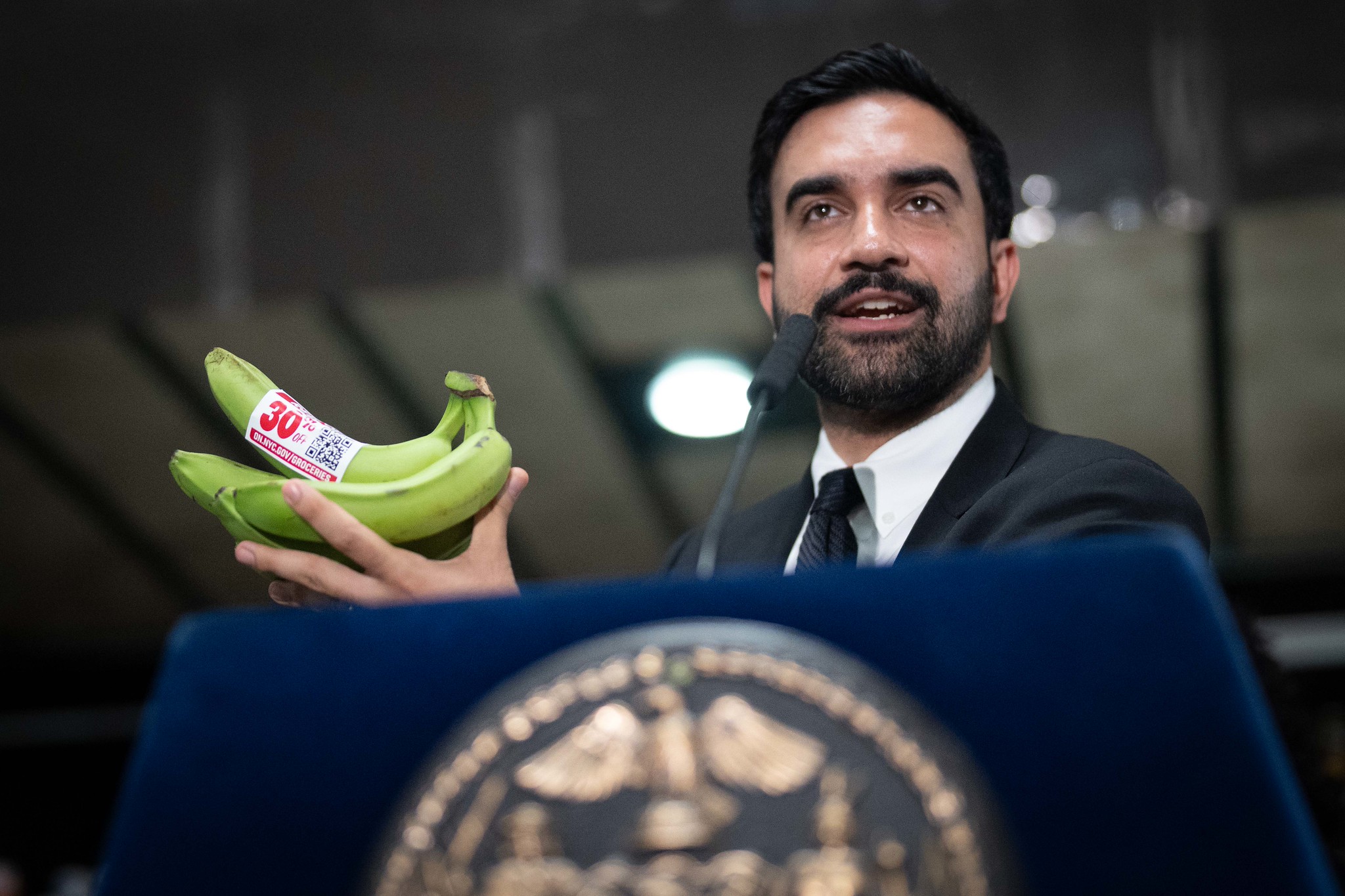
In late 2024, Zohran Mamdani, then a member of New York State’s assembly, posted a video of himself talking directly to the camera in a grocery store aisle. “Grocery prices are out of control. The cost of eggs and milk has skyrocketed,” he said. “It doesn’t need to be this way.” He went on to explain that, should he be elected mayor of New York City, he would create a network of city-owned grocery stores whose mission would be “lower prices, not price gouging,” he said, adding, “It’s like a public option for produce.”
“The job of city government isn’t to tinker around the edges while one in four children across our city go hungry,” he said.
High and rising food costs have been top of mind for most Americans: they were up 4.2 percent in May compared to the year before after climbing rapidly in the post-pandemic period. In New York City, food was the third largest expense for the average household in 2022-2023, consuming about 13 percent of families’ budgets. “The point of city government is to make people’s lives easier,” Mamdani told me in 2025 while still a candidate. Hence public grocery stores.
“This is for all New Yorkers,” he added. “It must be seen as the most obvious choice for New Yorkers of each and all class backgrounds.”
Mamdani is now mayor of New York, and he’s fulfilling that campaign promise. In April, he announced that his administration had selected its first site for a public grocery store: La Marqueta in East Harlem, where the city plans to open a 9,000-square-foot store by late 2027. Then in May he said he would also open a 20,000-square-foot-store in the Hunts Point neighborhood of the Bronx by the end of next year.
Mamdani isn’t the only leader of an American city that wants to address the high cost of food. “What’s keeping local leaders awake at night,” said Katya Spear, managing director of the Mayors Innovation Project, is that “residents are facing an unprecedented affordability crisis that extends to and beyond the grocery aisle.” As the old toolbox of tax incentives and food stamps fails to adequately fix the problem, a number have turned to the idea of public grocery stores. “Part of why we’re seeing interest in public grocery stores is because of the failure of the existing playbook we have to solve this problem,” said Taylor Jo Isenberg, executive director of the Economic Security Project. “Our existing playbook has failed. We need to try new stuff.”
Those who study the idea say that public grocery stores can fit well into the infrastructure of what cities offer their residents. “What is the role and obligation of the state to securing people’s everyday needs?” asked Justin Myers, associate professor of sociology at California State University, Fresno. In the United States, most of the response to the right to not go hungry has been on the consumption side by offering benefits like food stamps or even free school meals. But when it comes to the right to an education, for instance, the state directly provides public schools to all children. “Public grocery stores [are] another way the state can intervene in the larger structure to secure people’s right to food,” he said. They can be “part of the public infrastructure the way we see parks and fire services and educational services.”
Ivan Luevanos-Elms, executive director of Local Progress, has been pushing the leaders of American cities and counties to consider public grocery stores as part of a campaign to ensure “our local communities, whether they need food, whether they need healthcare, whether they need housing, that local governments are willing to be that entity that catches them and allows them to get back on their feet,” he said. “If we want to build momentum, we have to demonstrate that it works.”
But the ideas vary, as do the solutions they’re meant to address. “The main objective is to make sure that affordable food is available to people who need affordable food,” said Nevin Cohen, the director of the Urban Food Policy Institute at the City University of New York. Ideally, public grocery stores address both problems: a lack of access to fresh and healthy food, as well as the inability to afford it.
Traditionally, local politicians have focused food policy on addressing food deserts, places with little access to grocery stores. It’s a real problem—over 50 million Americans live in such areas—that has been identified for decades and has long plagued low-income communities, particularly those of color. Tax incentive programs and rezoning initiatives sprung up to entice private grocery stores to open up in these deserts. Many of those programs didn’t work out: Chicago spent $10 million, for example, on a tax break to entice Whole Foods to open up on the South Side, but it closed just six years later. “For a long time, municipalities were trying to coax private operations to come and invest in their communities with tax breaks, essentially interest-free loans, to open up shop,” said Erion Malasi, Illinois director of policy and research at the Economic Security Project. “But the moment those tax breaks ran out, grocery stores were leaving.” Public grocery stores, on the other hand, give municipalities a stake in the outcomes instead of just throwing money at the problem. “People are sick of corporate giveaways,” Malasi noted. “Why are we giving people zero interest loans to operate with no consequences for having left, no payback mechanisms, no clawback?”
Meanwhile, tax incentives to solve food deserts are “just focusing on geographic access and it assumes geographic access is going to create economic access,” Myers said. “None of the research really backs that up.” In his and Wesleyan University Assistant Professor Christine Caruso’s research, they found that simply bringing a grocery store to a low-income neighborhood “does not necessarily increase food access in a meaningful way because price points are still too high,” they wrote.
Some see them as being able to go even further: “It’s not just about bringing food access and securing the right to food, but also thinking of them as a way to create high-growth jobs,” Myers said. They can stand in opposition to big box stores like Walmart and Kroger not just in entering underserved areas and offering lower prices, but by offering decent employment. Cities can decide to offer residents healthier options, and they can also bring in other services, such as hubs to connect people with government programs that can be difficult to sign up for. At their best, public grocery stores can act as a public option, pressuring private operators to open new locations and compete on prices, lowering costs, and even treat employees better. “A public grocery store that just wholesales food can expose the real cost of goods,” Malasi pointed out. “It does put pressure on the marketplace.” And unlike food stamps, which are reserved for low-income people who meet the eligibility requirements, public grocery stores are for everyone, which should shed a lot of the stigma that comes with means-tested programs.
The United States already has a vast, current example of a truly publicly owned and operated grocery store. Starting in the 1800s, the U.S. Department of Defense has run commissaries throughout the country and even abroad. The Defense Commissary Agency (DeCA) runs over stores 200 worldwide and 177 on North American bases. The government fully owns and operates these stores, which are staffed by either direct government employees or federal contractors. The direct employees are unionized and enjoy the benefits of government employment: typically higher pay and better healthcare and retirement. Such a model removes labor costs from the operating costs faced by the stores themselves, with the government footing the bill.
Congress mandated that the commissaries offer food at a discount and infused funding to make up the difference. Food is sold at cost with no sales tax and a small surcharge, about 5 percent, to cover operating costs like store construction and upkeep, so prices average 25 percent below private grocery stores. DeCA is also able to leverage its enormous buying buyer to negotiate lower prices from food suppliers. “Service members love them,” said Errol Schweizer, a member of the IPES-Food panel who has over 30 years of experience in the food industry.
“The United States already has the largest functioning public grocery sector in the world,” Schweizer added. The ideal would be “to establish a civilian version of that.”
It’s a model at least one city is already trying out. St. Paul, Kansas, a rural town in the state’s southeast, went without a grocery store for nearly two decades after the single store on main street closed in 1985. Then in 2005, a group of residents and newly elected Mayor Rick Giefer created a community development entity that built a store and the necessary equipment and bought a membership into a food wholesaler cooperative. The city then brought in a couple with experience in managing grocery stores to operate the store, but when they decided to retire in 2013, the city assumed full control of the store’s operation and hired a different couple as municipal employees, with city-funded benefits, to run it. It now has 15 municipal employees and manages to turn a 3 percent profit.
Doing something like that in New York City would cost at least $20 million a year, according to Schweizer and Raj Patel’s calculations. But that is not what Mamdani has chosen to do. His administration has said it is eschewing the fully government run commissary model and is instead picking a private grocery provider to operate the stores, although no selection has been made yet. “That is the fastest way to get these up and running,” Isenberg noted. And speed likely matters. It’s meant “to show people that government can work in their lives in demonstrable ways and deliver to meet their needs,” she said.
New York City is deploying municipal grocery stores to address food deserts, but it’s mostly focused on affordability. “New York City is obviously a really dense city, there are supermarkets and bodegas everywhere, but the food affordability crisis is really laid bare here,” said Deandra Khan, senior advisor for strategic initiatives in Mamdani’s Office for Economic Justice. “It’s impacting so many people, it’s not just the poorest of the poor.” As of 2023, 1.4 million New Yorkers were food insecure, meaning they weren’t able to access enough food due to lack of resources. “Many people in a city like New York just have insufficient income to put healthy food on the table,” Cohen said.
Mamdani said he would redirect the $140 million that the city spends on its FRESH program for tax breaks and incentives for private grocery stores to instead open the city-run ones. FRESH didn’t entice private grocery stores into some of the more poorly served neighborhoods, nor did it guarantee lower prices or even require stores to accept food stamps or the Women, Infants, and Children program.
By not having to pay rent or taxes, and by removing the profit motive, candidate Mamdani argued that costs in his public grocery stores would be kept low. “This is an opportunity to show what the price could actually be if we were being honest about supply chain issues, honest about the impact of profits as part of this equation,” he told me. Part of doing that will be locating the first two stores on city-owned land. The last three in Queens, Brooklyn, and Staten Island will be on private property, but the city will waive taxes. In both cases, the city will mandate that a private operator pass all of those savings directly on to consumers in the form of cheaper food.
The Mamdani administration picked the sites for the first two stores because they are neighborhoods that have high shares of residents who can’t afford basic needs, Khan said. Still, the city is clear that the stores are meant universally, for all New Yorkers. “We believe that all New Yorkers are welcome in our stores,” Khan said. While Mamdani is starting with five pilot sites, one in each borough, by the end of his first term, his ultimate aim is to spread them across the city. “The goal of it is to ensure that every New Yorker can afford the groceries that they need,” he told me.
Some details remain unclear, such as exactly which foods will be subsidized in price and, if so, by how much. Will it be a basket of core products or will all food in the city-subsidized stores come at a discount? Will the city only force a private provider to pass on the savings in rent and taxes to consumers with lower prices or will it actually spend funding to lower the costs as in the commissary model? Will the city expect the stores to lose money, break even, or even generate a surplus that can be reinvested into creating new stores and keeping up the existing ones? Will the focus be on profit-making and efficiency or on the efficacy of getting cheaper food to city residents?
With a private provider, store employees will almost certainly not be on the city payroll, although Mamdani had planned on such a model as a candidate—“The employees of the store will be union members, public sector employees, and under prevailing wage agreements,” he told me last year. But the city can still use its power to demand that the operator adhere to certain labor standards. If the first five sites are meant as pilots to eventually expand, the private company may see signing up as a growth opportunity and be willing to agree to such terms. “I don’t see why [the city] can’t insist upon working conditions and worker rights,” Myers said.
Meanwhile, the city doesn’t have to remain locked into a public/private partnership if the stores go well and leaders decide to eventually pursue a fully government-owned and operated model like the DeCA commissaries. It can use the pilot programs to figure out things like procurement and community support and then launch a different model later on, Malasi argued.
Atlanta is focused on solving a different problem than New York: filling in the city’s gaps where there aren’t any decent grocery store options. “People need access to fresh food,” Mayor Andre Dickens told me earlier this year. “Food is a critical part of a healthy community.” In his city, the local government had tried for many years to attract private providers to neighborhoods that lacked grocery stores with tax discounts, to no avail. Dickens tried that tactic himself, offering up incentives that went beyond tax breaks to even try to entice private grocery stores by promising to give them land for free, build a store for free, or even subsidize their losses. All of the major retailers said no. “I got frustrated and I was like, ‘We’re going to do it ourselves,’” he said.
Dickens decided to spend $8 million in city funding to provide the land, build the building, and issue grants to subsidize losses. He found Savi Provisions, a private grocer, which was willing to come in and run the store. Savi Provisions has also partnered with the Independent Grocers Association to tap into its distribution networks with the goal of getting lower-cost products.
Azalea Market, as the store that is now up and running is called, is a purely public/private partnership—Kate Molla, deputy chief of staff to Dickens, called it a “municipally powered grocery store”—and affordability is not at the core of its goals. Instead, it’s a vehicle to get grocery offerings into places that didn’t have them and the private sector didn’t want to touch, with some requirements for the freshness of the food and a discounted group of basics. “We aren’t in the business of trying to prove that public grocery works better than the private market,” Molla said. “We are doing it out of absolute necessity because we aren’t having the success of getting private attraction.” The city wants the stores to turn enough profit to be self-sustaining and no longer need city funding in three to five years. For its part, Savi Provisions wants that to happen even faster—within one or two years.
Atlanta plans to open a second store by the fall in another neighborhood that similarly lacks access to fresh food. The city will then likely start work on opening a third or even fourth such store next year. It’s simultaneously still trying to bring private grocery stores to underserved neighborhoods with incentives. “We have not given up on that, Molla said.
Chicago initially wanted to be the first big city in the country to open a publicly owned grocery store in 2025. The city has a highly concentrated grocery market, where two large companies—Kroger and Albertsons—own nearly all the stores; when they were on the verge of merging, it would have created a near monopoly. But local nonprofits and local food businesses were still angry at being passed over when the city gave $10 million to Whole Foods, and after conversations with them and the community, the city pivoted early last year to instead open a public market to sell staples and create spaces for farmers and local entrepreneurs to sell their products. It will allow such offerings to be year-round, not just at farmer’s markets in the summer. That model can support small businesses and vendors who set up shop inside, and it can bring economic development to the area that surrounds the market. “Public markets are not only a solution to food access, but also serve all of these other purposes and are very flexible,” said Max Budovitch, Chicago deputy mayor for business and economic development. As in Atlanta, the market is expected to be self-sustaining, he said.
New York City has its own history of government-run markets. Starting in the 1930s, the city built indoor markets to bring food carts off of city streets, six of which still operate. La Marqueta is one of them. Rents are kept low and products and offerings vary depending on the character of the surrounding neighborhood. But it’s an entirely different model, and it won’t accomplish the affordability that is at the heart of what Mamdani wants to accomplish.
The grocery business is not an easy one. Margins are thin, at just 1 to 2 percent; food goes moldy and stale or arrives damaged or even gets stolen. Sourcing cheap enough food and then managing how much and which products to stock is a challenge. A city that removes the burdens of rent and taxes can help a grocery store get to profitability faster: a feasibility study of such a store in Chicago found that it could earn an operating profit.
But procurement will be a huge part of making any public grocery store work. “You need good wholesale contracts and good supply chains,” Schweizer said. “Grocery is only as good as your supply chain.” The corporate grocery behemoths—Walmart, Kroger, Costco, and Albertsons—have been able to use their heft to force supplier deals that secure them cheap products while boxing out smaller competitors. If public grocery stores want to compete, they’ll need scale, too.
New York City already procures large amounts of food through its public schools, which deploy the Good Food Purchasing Program, requiring vendors to meet nutritional, environmental, and labor standards. The city “has a huge amount of buying power,” Caruso said, since it’s “already purchasing a lot of food for the largest public school district in the country.” The city can use that prowess and know-how to stock up its public grocery stores, too, while negotiating to keep prices low. It would just have to adapt its existing relationships to secure the kinds of foods that a grocery store would want to have on shelves, such as switching from flats of eggs to cartons.
But the benefits of scale that DeCA enjoys won’t be secured with just five stores around the city, Schweizer argued. It will be hard to move products and staff around to different stores as necessary. The city seems to be relying on a private operator to handle procurement relationships, rather than using its purchasing power to establish its own.
Public grocery stores may be a new idea that sounds radical, but it’s one that advocates believe has a long future. “I don’t see economic inequality and poverty going away,” Cohen noted. Municipal grocery stores that can ensure access to affordable food will continue to be a useful policy lever for leaders in American cities. A lot of the policies that determine whether Americans can access and afford food—antitrust enforcement to give independent grocers a shot, funding for food stamps, trade and foreign policy positions that drive costs up and down—are all things that can only be changed by the federal government. But local leaders can do this on their own. “Any city that faces income inequality and economic barriers to eating healthy food is a candidate,” Cohen said. “That is any city in the United States at this point.”
And many seem interested. Luevanos-Elms has briefed over 100 elected officials on the idea. Schweizer said he’s been on conference calls with people representing hundreds of cities who are looking at different public grocery models. “There’s energy,” he said. “I just think we’re at the beginning.”
Bryce Covert is an independent journalist writing about the economy. She is a contributing writer at The Nation, and her writing has appeared in the New York Times, New York Magazine, Bloomberg Businessweek, The Atlantic, Time Magazine, Wired, the New Republic, and others.
Related

From the Geneva Office

African food systems imploding: Impacts of the war in Ukraine
Refiloe Joala and Jan Urhahn
From the Geneva Office

Pesticides: An Expensive Business
BASIC, CCFD-Terre Solidaire, Corporate Europe Observatory, European Environmental Bureau, Good Food Good Farming, INKOTA, Public Eye, Rosa-Luxemburg-Stiftung and SOS Faim