What Did the 2026 World Cup Teach Us About the Future of Football?
Sean Jacobs and Ivan Pech
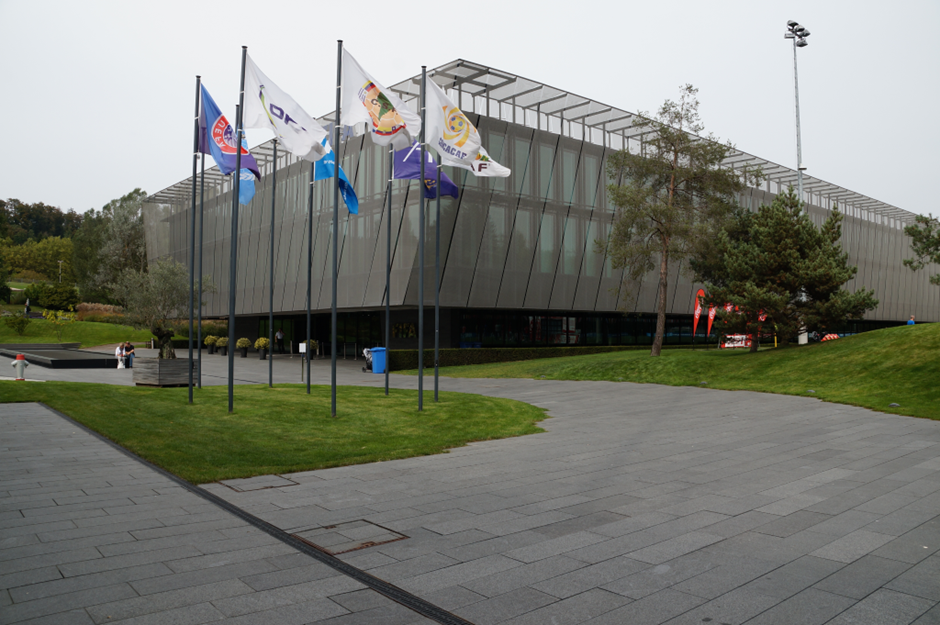
(FIFA Headquarters in Zurich with Continental Confederation flags)
For the most part, 2026 reminded us of the ugly side of the World Cup – and we’re not talking about Argentina’s anti-football: the negative, defensive, disruptive play, or the fact that, in the final, Argentina failed to register a single shot on goal during regulation time. No, we’re talking about what happened “beyond the boundary,” to borrow the Caribbean philosopher C.L.R. James’s phrase for the things that happen off and around the field.
That should not be surprising. The World Cup has always carried a troubling history: authoritarianism and corruption; the concentration of power and wealth in the hands of a small number of institutions and countries; and the dominance of the West alongside the marginalization of places once described as the colonies and the “Third World.” Long before the first ball was kicked, the 2026 World Cup had become a struggle over whom the tournament was really for – and who, ultimately, owned football.
That struggle will shape how the tournament is remembered. And it is mostly negative. The 2026 World Cup exposed, once again, how webs of commercial, political, and institutional interests have long overshadowed the world’s most popular sport – even as FIFA celebrated it as the most-attended World Cup in history. Expansion is now treated as inevitable. There’s talk of a 64-team World Cup. The tournament isn’t going anywhere; it will only keep growing. The more pressing question is: when will it be enough, and who gets to decide?
The first innovation – or concern – we can expect to continue began with ticket sales.
Tickets went on sale on September 10, 2025, nine months before kickoff. Even with access to the VISA presale—VISA has been FIFA’s official partner since 2007—fans quickly encountered a system designed to extract as much money from them as possible. FIFA introduced “dynamic pricing,” in which prices change in real time according to demand. Fans could wait hours in digital queues only to discover that the ticket they wanted had become more expensive.
As Brazilian economist Anna Olimpia de Moura Leite told us, FIFA’s unregulated ticketing pushed actual fans, particularly those from developing countries and immigrants from places where football is woven into daily life, outside the stadiums in the West or the Middle East, where it seems most World Cups will be held in the future.
That marked a sharp departure from recent World Cups. FIFA once made efforts to keep tickets within reach of local fans, including special low-cost “Category 4” tickets reserved for host-country residents. At the 2010 tournament in South Africa, about 15 percent of tickets were in this category, starting at around $20. In Brazil in 2014, 400,000 such tickets were set aside, starting at $30, with an additional 50 percent discount for students, seniors and people receiving social support. In Qatar, FIFA moved away from tiered pricing but retained some resident-based pricing and phased sales.
Football is basically falling in line with other sectors. Ticketmaster has helped popularize dynamic pricing for coveted events such as Taylor Swift’s Eras Tour, the Oasis band reunion and, most recently, Harry Styles’ Together Together Tour. It is likely to remain part of the live-event economy. The World Cup’s record attendance will be cited as proof that demand exists.
But attendance tells only part of the story. The 2026 tournament may have welcomed more nations and spectators than any World Cup before it while making the event less accessible to the ordinary fans—and, in some cases, football officials—who are supposed to constitute its constituency.
That is the contradiction: FIFA can call the tournament bigger and more successful than ever while the people who make football what it is find themselves increasingly priced out.
A second unpopular decision will be over who is allowed into the host country.
There is, of course, a history of host governments restricting access to major sporting events. Countries have denied entry to particular fans—most notably violent ultras or hooligans—when there was a clear security rationale. But what happened in the United States went a step further. Rather than targeting individuals because of their behavior, the policy tapped into and amplified a broader white-nationalist, xenophobic, and anti-Islamic mood in American politics. The passport itself became a proxy for suspicion. For a tournament that is supposed to bring people together, that is a particularly ugly form of exclusion. For the most part, Canada followed the US’s example, while Mexico turned out to be the most welcoming to fans.
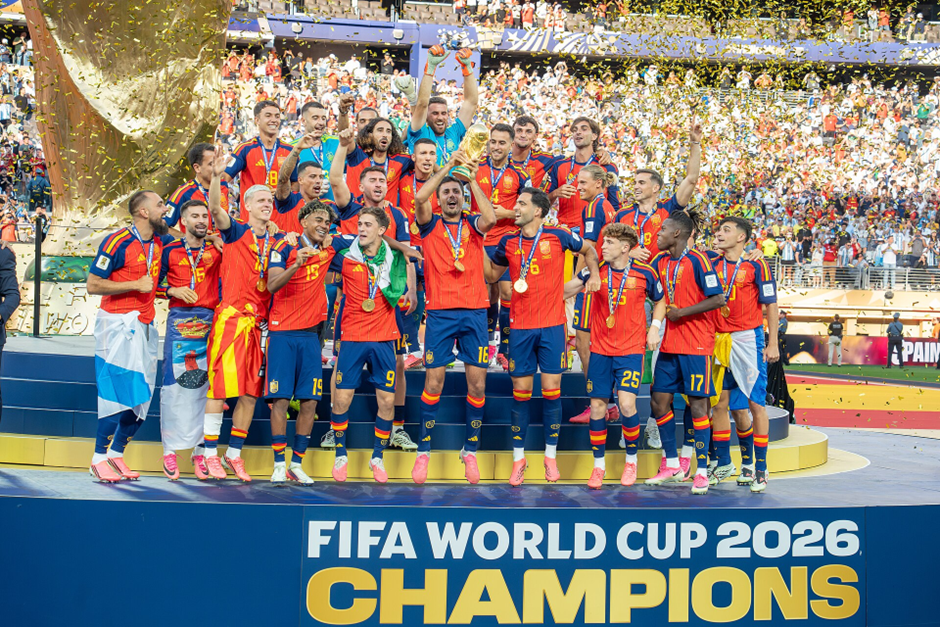
(2026 World Cup Champions Spain raise the trophy after the stage is cleared)
FIFA’s bidding rules in 2017 for nations seeking to host the World Cup stated that visa processing “must be applied in a non-discriminatory manner,” with the caveat that it must not “adversely affect the national immigration and security standards.” In practice, that principle was not respected. FIFA president Gianni Infantino effectively acknowledged the limits of the organization’s power, without appearing particularly troubled. “We always try to find solutions – always,” Infantino said at a news conference in Mexico City. “But then we need to respect that we are not the kings of the world who can rule over governments and police forces and I don’t know what. We are a sports organization; we try to do our best with the means that we have.”
The most high-profile case was that of Omer Artan, whom many consider the best referee on the African continent, whose U.S. visa was denied because of his nationality. He is Somali, and his country is among 75 countries included on the U.S. travel-ban list, a policy the U.S. government recently reversed, but one that created problems for the World Cup nonetheless. Artan was not the only one caught up in these policies. The Iran national team was also made an example of by the US. In addition, fans of Haiti, which competed in the World Cup, were subject to a blanket travel ban (there’s a long history of racism in America’s immigration system against them), and Senegal and Côte d’Ivoire, two other teams that qualified, were subject to partial travel bans.
Iran’s forced relocation from California to Tijuana, Mexico, could have become another symbol of exclusion. Instead, it became a story of welcome. Tijuana offered Iran a home away from home. When Iran was knocked out—courtesy of some dubious refereeing—the team left a message worth remembering: “May peace, respect, and friendship prevail among all nations.”
That, rather than the passport bans and exclusions, is the spirit a World Cup ought to represent. It will be worth watching whether it becomes the norm in future editions of the tournament.
Since the 1970s, advertising and television rights have become central to the World Cup’s profitability. As FIFA has grown into a global commercial behemoth, its determination to extract as much money as possible from the tournament has only intensified. At this World Cup, that imperative was on steroids.
That is partly because the tournament was being staged in the United States, where an ethos of turning major sporting events into relentlessly commercial, television-friendly spectacles is particularly entrenched. Increasingly, that approach is becoming the dominant model for the World Cup itself: more entertainment, more opportunities for advertising, more content and more ways to monetize the audience.
The introduction of FIFA’s first compilation album and a Super Bowl-style halftime show are perhaps the clearest expressions of this shift. The World Cup has had an official song since 1990, but this was the first time FIFA released an entire album to accompany the tournament, with the music played before matches. According to FIFA’s official figures, the album generated at least 336 million streams. Expect it to stick around. So will the halftime show. Major tournaments have long had pregame entertainment, but this was the first World Cup to introduce a halftime spectacle.
The response was hardly universal acclaim. Fans and pundits criticized the show, while the BBC and Turkey’s TRT Sport initially refused to carry it. The BBC eventually incorporated some elements into its broadcast. But criticism is unlikely to stop either innovation from becoming part of the tournament’s future. Once FIFA discovers another piece of valuable television real estate, it is unlikely to give it back.
The same logic can be seen in the increasingly prominent use of hydration breaks. Water breaks were used at the previous World Cup in Qatar, where the extreme heat famously forced the tournament into December. At this edition, however, FIFA made them mandatory. Other competitions, including Mexico’s Liga MX and CONMEBOL tournaments, have since adopted similar stoppages, although they are not mandatory outside FIFA’s competitions.
The breaks have an obvious sporting justification, particularly in hot conditions. But they also create another predictable interruption around which broadcasters can build commercial inventory. Even when matches are played indoors, the logic remains: every stoppage is another piece of the game that can be packaged, sold and monetized.
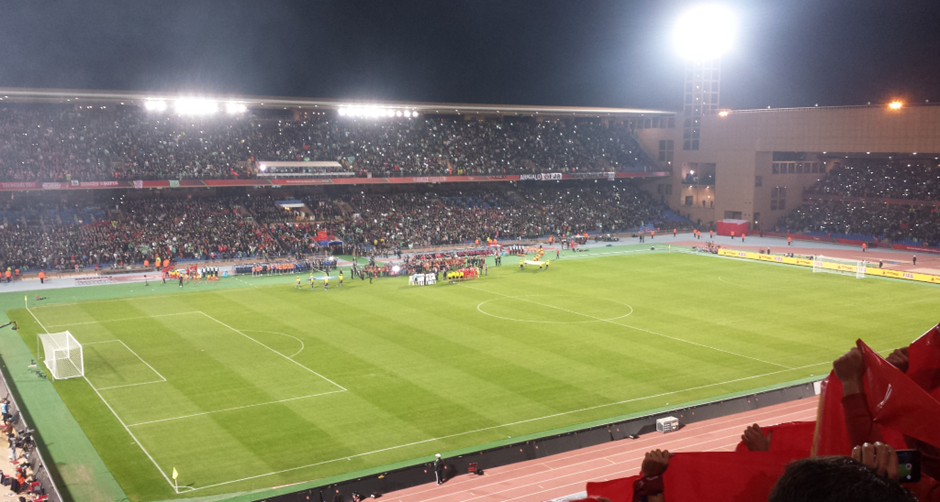
(Stade de Marrakech, Fifa 2030 Worldcup host site)
It will be worth watching whether hydration breaks appear at next year’s Women’s World Cup in Brazil, even though the tournament will be played during the country’s winter. And as the World Cup continues to move through hot-weather locations—including Saudi Arabia in 2030—the debate over cooling and hydration breaks will continue.
The larger point is that none of this is accidental. FIFA has always wanted to make money from the World Cup; that is hardly ne
Despite FIFA and the hosts’ efforts to police what could be said and displayed around the tournament—and with future World Cup hosts likely to continue discouraging fan expression of political demands deemed outside the mainstream—Palestine was once again a fixture among supporters, as it had been in Qatar, where it was dubbed the “33rd team.” Its presence was a rejection not only of FIFA’s attempts to keep politics out of football, but also of the American war propaganda surrounding its illegal war on Iran.
More importantly, though, the World Cup affirmed something more hopeful: the insistence that identities are global, and that nations can expand rather than contract. We saw this in the teams that performed beyond expectations and in the ways they drew, to their advantage, on the global nature of their footballing communities. The success of the Democratic Republic of Congo, Cape Verde and Curaçao, alongside France’s continued ability to draw on its enormous and diverse diaspora, showed that football’s communities are often far more expansive and open than the political classes, rulers and media that claim to speak for them. That is an encouraging sign for the future.
In this expanding footballing world, we can expect more diaspora talent to emerge. Nearly one in four players at the World Cup was born in a different country from the one they represented. The performances of teams once considered marginal to world football—Curaçao, the DRC and Morocco, to name a few – will increasingly become the norm. In Curaçao’s squad, only midfielder Tahith Chong was born on the island; he grew up in the Netherlands and now plays his club football in England. Most of Morocco’s team were either born or raised in Western European countries with large, visible Moroccan diasporas. Their captain, Paris Saint-Germain defender Achraf Hakimi, was born in Spain and speaks more Spanish than Moroccan Arabic.
As more countries qualify, football federations will continue expanding their reach into diaspora communities. Competition for talent between federations will intensify. This will bring its own controversies, but it also reflects a fundamental truth about the modern game: footballers—and the communities that support them—do not fit neatly into the borders drawn by states.
For better, and sometimes for worse, FIFA has stretched the boundaries of what is possible not only on the field but in the fan experience. More encouragingly, supporters and players have stretched those boundaries too. They have shown that football’s world is bigger, more mobile and more interconnected than the political world around it. If that continues, the future of the World Cup may be considerably more expansive—and more interesting—than its governing body or its hosts might wish.