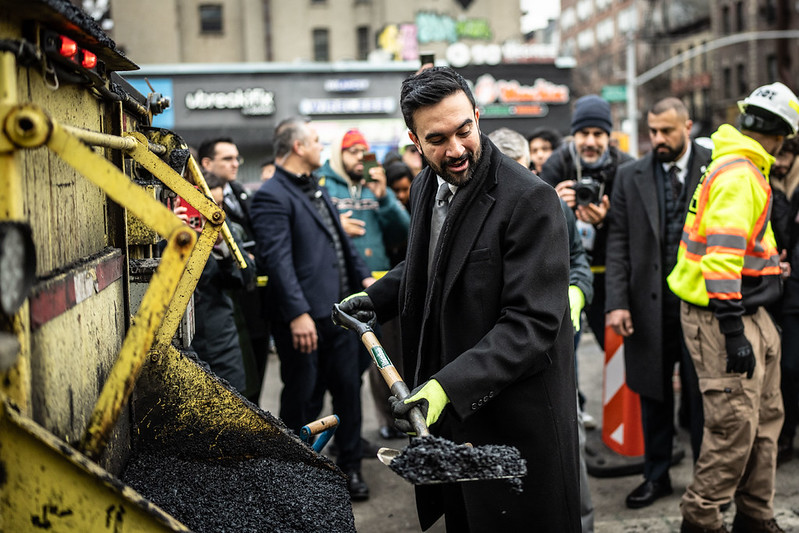
100 Days of Mayor Mamdani: Promising Progress
Stefan LiebichSince his inauguration as mayor of New York City, Zohran Mamdani has been swiftly implementing his core campaign promises. But the limitations of pragmatic governance are also gradually becoming clear.
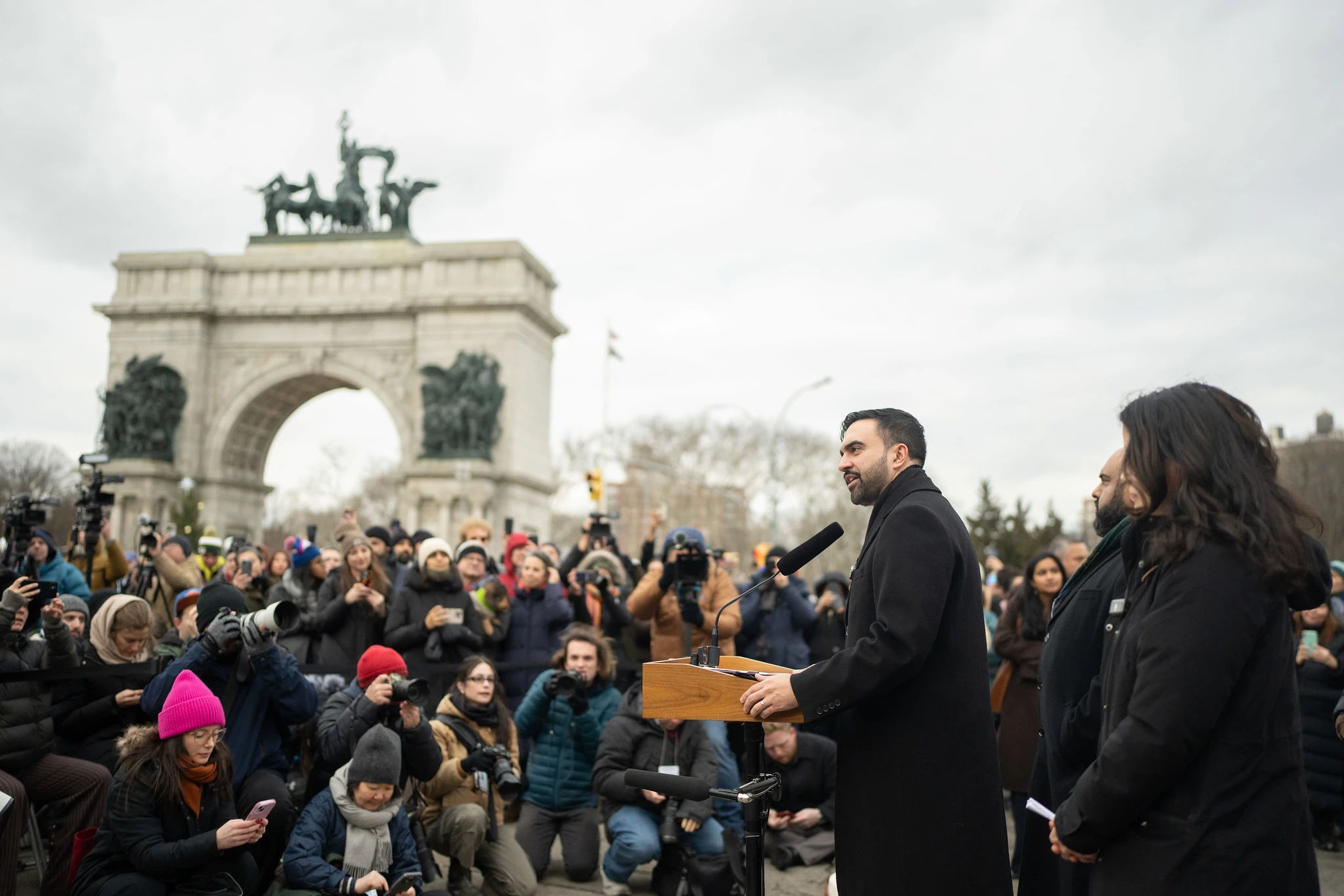
Since 1 January 2026, democratic socialist Zohran Mamdani has served as the mayor of New York. Speaking at his inauguration ceremony outside City Hall on that freezing day, left-wing New York congresswoman Alexandria Ocasio-Cortez proclaimed “We have chosen courage over fear. We have chosen prosperity for the many over spoils for the few.”
Bernie Sanders, the independent senator from Vermont who has been instrumental in the rise of the Democratic Socialists of America (DSA), of which Mamdani and Ocasio-Cortez are both members, swore in the incoming mayor.
In his speech, Mamdani remarked: “I have been told that this is the occasion to reset expectations. That I should use this opportunity to encourage the people of New York to ask for little and expect even less. I will do no such thing. The only expectation I seek to reset is that of small expectations.”
Mamdani’s campaign had promised a decisive departure from the policies of his predecessor Eric Adams, as well as from those of the Democratic establishment more broadly. His actions must now be measured against that promise.
During his election campaign, Mamdani pledged to radically reorient urban policy around social justice, increased state intervention, and more active community involvement. In politics, it is uncommon for voters to be well-versed in the specifics of a particular candidate’s campaign. But in New York City, everyone is familiar with Mamdani’s three major objectives: a rent freeze for rent-controlled housing, universal childcare, and fast and fare-free city bus services. These policies paved the way for his resounding electoral victory.
As the first 100 days of Mamdani’s tenure are approaching, he is clearly ushering in an ambitious programme of reforms — but there are first signs of political tension, structural challenges, and budding controversy.
The Rent is Too Damn High
On his first day in office, Mamdani delivered a powerful message: he revoked a number of executive orders put in place by his predecessor Eric Adams and appointed Cea Weaver, a well-known tenants’ rights activist — with whom the Rosa-Luxemburg-Stiftung’s New York branch has collaborated for a number of years — as director of the revitalized Mayor’s Office to Protect Tenants. The office was established in 2019 by then Mayor Bill de Blasio but was closed again under Adams. By reviving it, Mamdani has underscored just how crucial housing policy is for his administration.
The very next day, Mamdani established the Office of Mass Engagement, which aims to involve members of the public in political decision-making processes more closely. The principle that underpins this move is remarkable: The city’s administration should not simply manage the city; it should actively organize it’s residents. Citizens should be encouraged to engage politically and advocate for their interests. The office will also offer practical support to people facing eviction or firing.
On 4 January, Mamdani announced his “Rental Ripoff Hearings” — public hearings to be held in all five boroughs of the city, where tenants would have the opportunity to share their experiences with exploitative landlords. The idea is to draw attention to abuses committed by landlords and to develop potential political countermeasures.
At the same time, Mamdani’s administration also started to crack down on other unfair practices: a task force charged with combatting hidden fees as well as investigating subscription traps and excessive additional cost was set up. This has been followed by a number of spectacular settlements with property companies, including a $2.1 million court ruling against a landlord accused of systematically scamming tenants and committing thousands of building code violations.
Mamdani took a decisive step on 18 February when he appointed new members to the Rent Guidelines Board, the body responsible for determining rent adjustments for some one million rent-controlled homes in the city. With these new appointments, Mamdani greatly increased the likelihood of a rent freeze — one of his three central election promises.
The city also published a list of the 250 buildings with the worst housing conditions and announced stricter checks and controls. This combination of public pressure, regulation, and legal measures reflects a clear strategy: finally holding landlords to account.
First Steps in Childcare
Another of the new administration’s priorities has been childcare, the second of Mamdani’s three election promises. On 8 January, Mamdani and Kathy Hochul, Governor of New York, jointly announced a one billion dollar programme to vastly increase the number of childcare spots available to residents of New York City.
What this means in concrete terms is that the city’s current kindergarten programme for three-year-olds (3-K) will be made accessible to all. A new programme for two-year-olds (“2-Care”) will also be introduced, which will initially consist of some 2,000 spots before being expanded in subsequent years. Notably, access will not be income-dependent. It is important to note, however, that Mamdani is not immediately fulfilling his campaign promise, but rather taking some first steps by means of compromise. There is still a great deal to be done on this front.
Mamdani also launched an extensive awareness campaign to encourage parents to enroll their children — a much-needed initiative, given that many families were unaware that they were eligible for these services.
Mamdani was also quick to enact some first changes to labour legislation. On 30 January, he announced a major settlement with a number of delivery services including Uber Eats, which were forced to pay out millions to workers and to reinstate thousands of previously deactivated drivers. The move sends a clear signal that the administration plans to crack down on precarious working conditions in the gig economy.
This settlement was followed by additional measures: stricter monitoring of tax advisors, support for free tax advice, and new regulations that protect workers’ rights, such as the right to take time off to care for children or attend medical appointments. In the US, local administrations often have greater leeway when it comes to regulating things like labour rights, which in Europe tend to be subject to state or national legislation. It is this wealth of administrative powers that makes the New York‘s mayoral office so significant.
Mamdani on the National and Global Stage
Although foreign policy is not typically part of a mayor’s remit, Mamdani has also left his mark on international politics. He criticized the kidnapping of Venezuelan President Maduro by the US government, spoke out against the war on Iran, and lobbied successfully for the release of an imprisoned Palestine solidarity activist.
One particularly politically charged issue has been Mamdani’s stance on immigration policy. On 6 February, he signed an executive order reaffirming and expanding New York’s status as a sanctuary city. This will make it harder for federal agencies such as ICE to target immigrants on city-owned premises.
A task force has also been set up to respond to any potential large-scale ICE operations, and an outreach campaign has been launched to inform immigrants of their rights. These measures place New York in firm opposition to much more restrictive federal immigration policy.
In addition to these larger reforms, Mamdani has also implemented a number of smaller but symbolically significant measures. These include investing in public toilet infrastructure, parks in underprivileged neighbourhoods, and programmes to support small businesses, including a fund offering low-interest loans.
Progress has also been made on the issue of houselessness, including an expansion of support services and new strategies for shelters. But at the same time, the administration also faced criticism after 18 unhoused people died during a recent period of extreme cold.
Budget Issues
As one might expect, the first few months of Mamdani’s tenure have not been without their share of conflict. Above all, Mamdani’s response to a fatal police operation in January, when he initially sided with the police, was met with resounding criticism. He later changed course. He also faced opposition for his decision not to expand a substantial housing subsidy programme, thereby directly contradicting one of his campaign promises. In this case, Mamdani faced public opposition from a left-wing member of the City Council for the first time.
One of the biggest challenges facing Mamdani is the strained budgetary situation. At the end of January, it emerged that New York City is anticipating a colossal deficit totalling billions of dollars in the coming years — a legacy of his predecessor Eric Adams.
During his election campaign, Mamdani proposed increasing taxes on the wealthy and on corporations, but implementing these measures will depend on approval from the New York state government. Democratic Governor Hochul has so far rejected these proposals, but pressure from the DSA and its supporters has been mounting, most recently at a rally with Bernie Sanders in the Bronx at the end of March. Should the proposal be rejected, Mamdani has warned of drastic cuts and increased property taxes, which would also impact small property owners and tenants. In doing this, he is taking a huge political risk.
In the meantime, Mamdani is endeavouring to improve his relationship with Governor Hochul, even demonstratively endorsing her in the ongoing New York state gubernatorial primaries. The endorsement also generated tensions within the DSA, especially since Hochul was taking action against striking workers in the healthcare sector at the time.
A Movement, Not a Moment
One of the cornerstones of Mamdani’s approach is building a political movement. On election night in his home constituency of Astoria, attendees at his victory party chanted “We are not a moment. We are a movement.” Mamdani’s institutional innovations such as the newly established Office of Mass Engagement and his political decisions, such as his endorsement of progressive candidates prove that he is taking this task seriously.
Mamdani’s goal is clear: transforming New York’s political landscape in the long term by broadening the base for left-wing politics. But at the same time, he finds himself balancing the expectations of his left-wing base and the constraints that pragmatic governance faces within the framework of existing legislation and available resources — a situation all left-wing governments invariably find themselves in.
Even though the DSA is represented in the New York City Council and in both houses of the New York state legislature, it is nowhere near a majority. This means that Mamdani has to rely on the support of other political players and will have to make certain compromises. But at the same time, a US mayor can issue executive orders to swiftly implement changes — a tool Mamdani used several times during his first few days in office. This ability would not be afforded a mayor in Berlin, for example. Given the fundamentally different institutional arrangements, Mamdani’s first 100 days in office can scarcely serve as a blueprint for a rebellious approach to governance in Germany for instance.
Nevertheless, following just over two months in office, Mamdani already has an impressive catalogue of initiatives under his belt. He has laid some crucial groundwork, most notably in housing, childcare, and workers’ rights.
At the same time, however, the structural limits of his policies are also becoming apparent: budgetary constraints, dependence on state institutions, and political tensions both within and beyond his own coalition.
It goes without saying, of course, that right-wing actors and media outlets are also attacking him. In particular the New York Post, a popular tabloid newspaper owned by Rupert Murdoch, as well as Mamdani’s mayoral predecessor Eric Adams have pulled no punches in their scathing criticisms of the new mayor’s policies or those of his appointed staff. For example, reporters from the New York Post ambushed Cea Weaver, the newly appointed director of the Mayor’s Office to Protect Tenants, outside her apartment, accosting her about the fact that her mother owns a house — something they claim contradicts her tenants’ advocacy.
So far, however, these attacks have proved unsuccessful. Mamdani continues to enjoy high approval ratings — higher than those of his predecessors Eric Adams and Michael Bloomberg. Obviously, his policies resonate positively with many New Yorkers.
Translated by Louise Pain and Marty Hiatt for Gegensatz Translation Collective
Stefan Liebich is Head of the RLS New York office for USA, Canada, and the United Nations
Top photo: Michael Appleton/Mayoral Photography Office
Related

Some NYC Homeless Practice Social Distancing in Hotels, with Help from Donors
Claudia Irizarry Aponte and Ben Fractenberg, THE CITY